
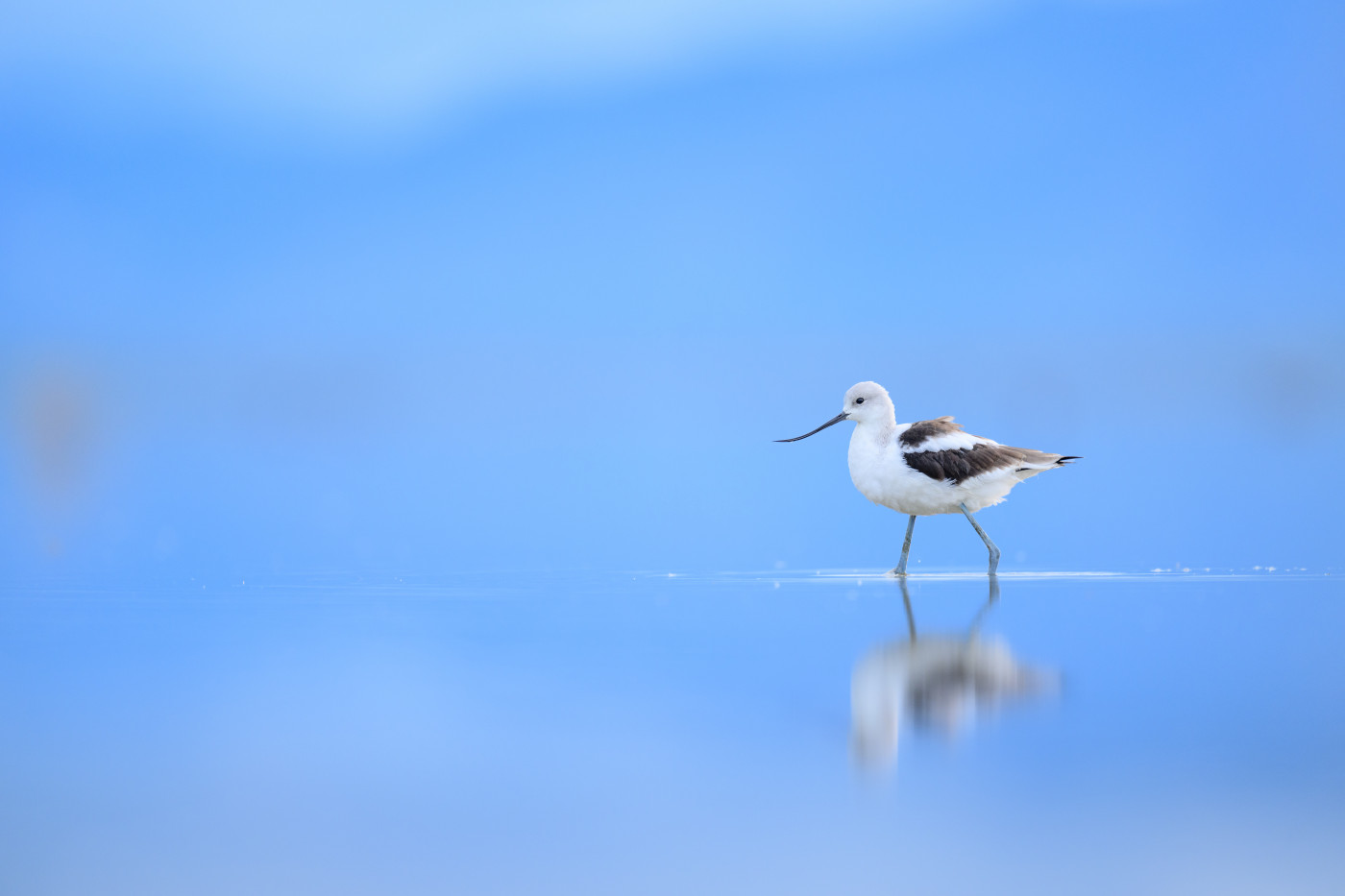
The biggest gathering place for migratory shorebirds in the Intermountain West is drying up. But where there’s still water, there’s still hope of keeping what’s left.
Note to readers • A version of this story originally appeared in Living Bird magazine, a quarterly magazine published by the Cornell Lab of Ornithology and is being republished by the Great Salt Lake Collaborative with permission.
At sunrise, five of us step off solid ground and onto salty mudflats, shouldering binoculars and cameras. Behind us, Utah’s Wasatch Mountains glow like sapphire; across Great Salt Lake—its shore more than a mile away—Antelope Island glimmers in shades of violet and gold.
Ahead of me, volunteer shorebird surveyors Esther Sumner and Felicia Alvarez pull a small blue wagon across the briny mud toward the lake’s south shore. Its wheels drag, caked with dirt, leaving long tracks across the dried-up, salty lakebed that used to be underwater. The wagon is piled with spotting scopes and data sheets needed to count the shorebirds we will encounter as we trudge across this otherworldly landscape.
“It’s free birding and a free workout,” Sumner laughs, her hip-length black hair flowing behind her as she leaves footprints in the mud.
And so the count begins.
Only minutes ago, we were immersed in the roar of semi-trucks as we drove along I-15, the state’s busiest freeway. Now, at Lee Creek Natural Area, in a stretch of Great Salt Lake shoreline closed to the public, it feels as if we’ve stepped off the map entirely.
As we walk, the shorebirds begin to appear. Two Long-billed Curlews move across the flats, their crescent-moon bills silhouetted against the pale ground. Willets call overhead, asking us “will it? will it? will it?”—their voices carrying across the open space before they come into view.
We are here as volunteers with the Intermountain West Shorebird Survey, a multistate effort launched in 2022 to understand what is happening to migratory shorebirds across a rapidly drying region. The project stretches from California to Wyoming and serves as a measure of ecological change across the network of saline lakes and wetlands in the West that birds have relied on for thousands of years. A recently published report of Intermountain West Shorebird Survey data compares today’s counts with surveys conducted more than three decades ago. The numbers of shorebirds counted across the region have fallen dramatically. Shorebird populations declined by 36% during fall counts and 53% in spring counts, with American Avocets—one of Great Salt Lake’s iconic species—down by an average of 68%.
A migratory Route for Millions
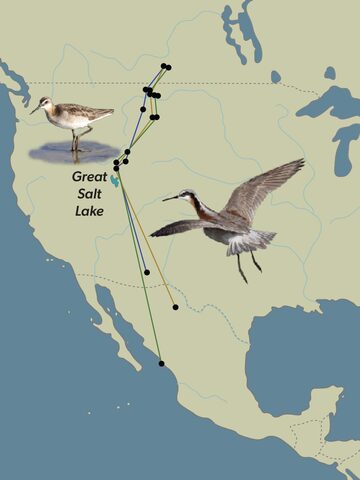
Migratory tracking of three Wilson’s Phalaropes shows the importance of Great Salt Lake as stopover habitat. Map graphic by Jillian Ditner/Living Bird Magazine, Autumn 2026. Tracking data from McKellar, A. Phalarope migration (Project 586). 2022-2026. Macaulay Library photos by Max Malmquist and Chris Turner.
Each year, millions of birds migrate through the Intermountain West, stopping at a scattered network of saline lakes and wetlands between Arctic breeding grounds and wintering areas as far south as Argentina. Great Salt Lake and its wetlands support around 40 species of these birds. The lake provides the brine shrimp, brine flies, shallow water, and mudflats that the birds need to rest and refuel along their journeys.
Since the 1980s, however, Great Salt Lake has shrunk by more than half. Agriculture, growing cities, and other human demands have diverted more water from its tributaries than the ecosystem can sustain. Because Great Salt Lake supports such a large share of migratory shorebirds, its decline reverberates across the hemisphere.
More than 130 volunteers have spread out across the lake’s shoreline and surrounding wetlands each spring and fall since 2022 to conduct this modern version of the shorebird survey.
After counting 20 Gadwalls, one Black-necked Stilt, six American Avocets, 18 Snowy Plovers, three Long-billed Curlews and eight Willets—along with hundreds of other birds, the team tallies the numbers. They tell me this year’s count is lower than usual. Utah’s warmest winter on record left little snowpack, pulling the lake farther from shore.
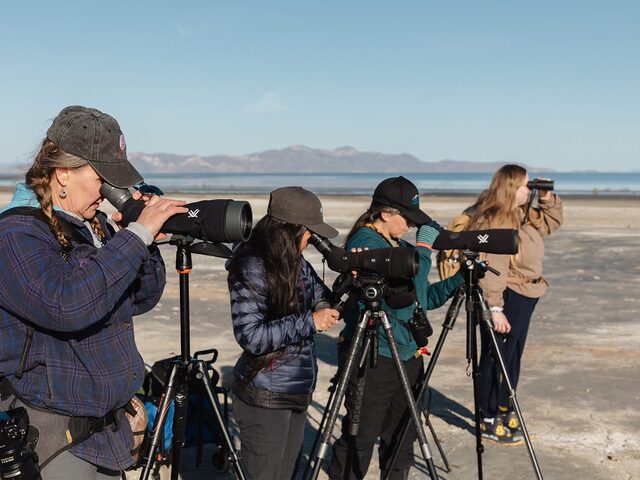
Shorebird counters Connie Misket, Esther Sumner, Felicia Alvarez, and author Clarissa Casper scan for shorebirds during the 2026 Intermountain West Shorebird Survey. Photo by Sierra Hastings
An hour later, we’re sitting in a Mexican restaurant in Salt Lake City, still in our muddy boots. Survey volunteers are sharing how much they’ve loved coming back to the Great Salt Lake every spring and fall to count shorebirds—even with the lake becoming smaller and the shorebirds fewer.
“It’s not worth giving up. There’s so much to dream, so much potential for this lake in the future, and there’s still something we can do about it now,” says Sierra Hastings, spokeswoman for Sageland Collaborative, the science-based wildlife conservation nonprofit that leads Utah’s survey.
In recent years, national newspaper headlines have described Great Salt Lake as a dying lake, an “environmental nuclear bomb” waiting to go off.
But, over chips and salsa, no one talks like the lake is already lost. Not because they doubt what’s happening to it. But because they’ve decided giving up isn’t an option.
Four days later I find myself peering through a spotting scope again, looking for the same bird species.
This time I’m at Farmington Bay, a wetland on Great Salt Lake’s eastern shore where shorebirds nest and forage between thin roads cut through brush. Scientists Janice Gardner and Emm Clark stand beside me, scopes zeroed in on a pair of American Avocets with rust-colored heads, black-and-white wings, and long, blue-tinged legs.
“There used to be so many more birds here,” says Gardner, executive director of Sageland Collaborative, as she steps back from the scope and looks across a pond packed with shorebirds. “It’s crazy to think about what it would have been like even just 30 or 100 years ago.”
The origins of this survey began in the late ‘80, when scientists set out to understand just how important stopover sites in the Intermountain West are for shorebirds migrating along the Pacific Flyway. At a time when most shorebird research was focused on the coasts, the effort revealed that the Intermountain West supported migrating shorebirds by the hundreds of thousands.
The resulting study, published in the journal Western Birds in 2002, identified Great Salt Lake as holding the greatest number of shorebirds of any wetland region throughout the Intermountain West. Researchers and volunteers estimated nearly 400,000 shorebirds during fall migration and nearly 70,000 shorebirds during spring migration. Nearly 80% of all American Avocets counted across the Intermountain West were tallied at Great Salt Lake, along with nearly 80% of the region’s migrating Black-necked Stilts.
“This is a wetland of hemispheric importance,” Gardner tells me as we scan a pond full of stilts. “From Canada to Argentina, this is literally one of the most important wetlands in the freaking world.”
A Shrinking Shoreline Spurs Action
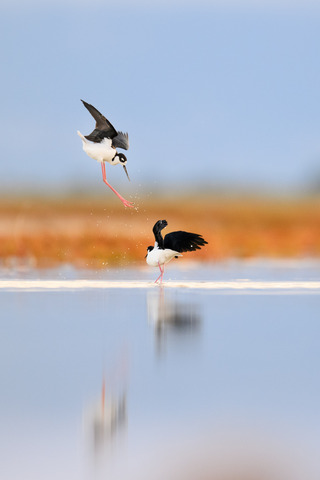
Black-necked Stilts hop and flap along the shores of Great Salt Lake. Shorebird survey data from the 1990s showed that nearly 80% of stilts migrating through the Intermountain West region stopped over at Great Salt Lake. Black-necked Stilts by Ray Hennessy.
Since the mid-1980s, Great Salt Lake has shrunk from 3,300 square miles to less than 1,000 square miles at its lowest point in 2022. Water levels have fallen more than 20 feet as rivers feeding the lake have been diverted for agriculture and growing cities, while rising winter temperatures have reduced snowpack.
When the lake reached its lowest recorded level in 2022, scientists and conservation groups rebooted the Intermountain West Shorebird Survey with a modern twist—not to discover what was there, but to understand what remained. Sageland Collaborative organized volunteers to resurvey sites around Great Salt Lake each spring and fall, retracing the routes of the original counts and visiting new ones.
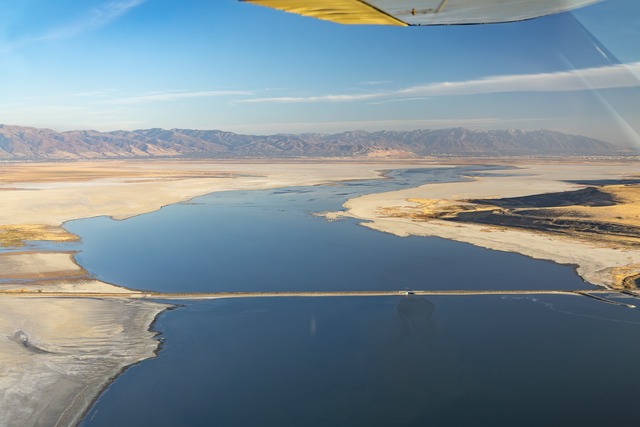
The receding shorelines of Great Salt Lake are evident from the Antelope Island Causeway, looking south into Farmington Bay. Photo by Mary Anne Karren.
But the goal extends beyond collecting data. Roughly 70% of survey participants are volunteers. Many have little connection to Great Salt Lake, but the shorebirds help form a bond.
“Great Salt Lake is so important to the community,” Clark, coordinator of Utah’s portion of the survey, adds, “but so many people are disconnected from it.… What we’re looking for is to spark that passion in other people for how amazing it is out here.”
The consequences of a shrinking Great Salt Lake extend far beyond birds. As the lake recedes, more lakebed is exposed, generating dust that contains arsenic and other metals. Researchers have found those contaminants can be inhaled, ingested, and even accumulate in crops.
There are economic consequences as well. As water levels fall, salinity rises, straining the lake’s food web. During the 2022 drought, the salinity of the main body of the lake climbed to nearly 19%, approaching the threshold that brine shrimp and brine flies can tolerate. (For comparison, the salinity of sea water is around 3.5%.)
Some might know brine shrimp as the “sea monkeys” advertised in the back of classic comic books. Shorebirds know these pink, translucent shrimp as a reliably abundant food source. Wilson’s Phalaropes, for example, can eat tens of thousands of brine shrimp in a day.
The brine shrimp of Great Salt Lake also fuel a multimillion-dollar industry, providing the world’s largest source of shrimp eggs for feeding fish farms.
Thankfully, an unusually wet winter followed the drought. Along with new government-directed water-conservation measures, Great Salt Lake stabilized by spring 2023.
Even so, “the rebound was not a recovery, but a reprieve,” says Gardner, the Sageland Collaborative executive director. Substantially more water is still needed, she says, to secure the future of the lake and the millions of birds that depend on it.
“These birds have been coming to Great Salt Lake for eons,” she says. “It’s in their DNA. So, if they come here and everything’s dry, the next wetland with enough food might be a thousand miles away. Do they have the reserves to make it? Some might. Others won’t. They just die.”
As we weave our way through the dry bay, continuing to count long-legged birds, I feel the urgency to get more water to this place. Before me hundreds of shorebirds are dipping their heads into ponds that look to be receding.
“Time is of the essence,” Gardner says.
More than Half of All Shorebirds in the Inland West
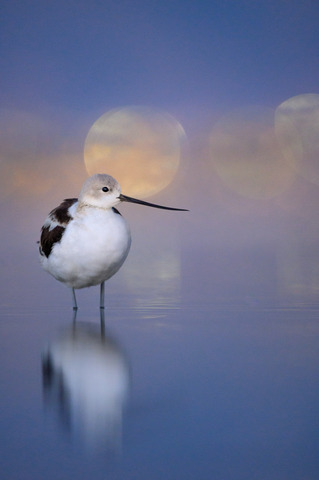
American Avocets by Ray Hennessy.
Sharon Montecino has felt that urgency as she has followed shorebirds across their migratory lives throughout the Western Hemisphere.
She has studied them on their wintering grounds in her home country of Chile and on their breeding grounds in Alaska. When she first arrived at Great Salt Lake in 2024—the missing link of a migratory pathway she had spent years tracing—she was transfixed.
“It was so impressive to see the quantities of [shorebirds],” says the ecologist and natural resources engineer. “... Here they are far away from the coast. It’s impressive to see them among the mountains in Utah.”
Montecino came to Utah State University after years working in bird conservation in Chile where she brought together scientists, community leaders, residents, land managers, and government agencies to protect shorebirds and their habitat.
She arrived in Utah hoping to expand her knowledge of conservation practices and study the birds she’s come to adore, in a place that she hadn’t been before. What she found was both beautiful and heartbreaking.
For her master’s research, Montecino analyzed shorebird survey data, comparing counts collected over the past four years with those conducted in the early 1990s.
Her preliminary results showed dramatic declines in shorebird numbers, and revealed just how important the region’s remaining wetlands have become. Just four saline lakes accounted for more than 75% of all shorebirds counted, while nine sites supported nearly 90% of birds moving through the region.
Above them all stood Great Salt Lake. Montecino says the lake now supports more than half of all shorebirds migrating through the Intermountain West each year.
“It’s really the most significant place … the most significant stopover for thousands of shorebirds,” Montecino says.
Buried within the declines was reason for hope. Montecino found that some wetlands that gained water between the two survey periods also gained birds. That finding suggests that shorebirds can respond quickly when habitat conditions improve.
“Significant increases in surface water level can create or restore suitable habitat for shorebirds,” Montecino says.
Montecino’s recommendations from her research: Send more water to wetlands. Strengthen the network of migratory stopover habitat. Improve connectivity between sites so birds have options when conditions change. And above all, replenish the Great Salt Lake.
“I think these things should mobilize us instead of freeze us,” Montecino says. “There are more reasons to keep going.”
Where Are You Going to Put 300,000 Phalaropes?
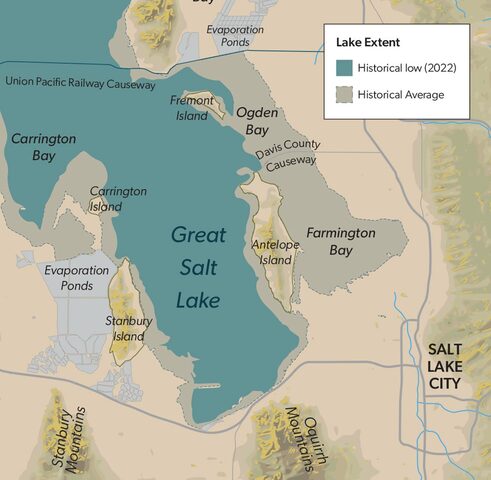
In 2022, drought reduced the lake’s surface area to its lowest measurement on record. Map by Jillian Ditner/Living Bird Magazine, Autumn 2026.
Shorebird scientist Ryan Carle has spent the past four years building a case for why a small peach-and-gray shorebird—the Wilson’s Phalarope—may be one key to saving Great Salt Lake.
Carle is a co-founder of the International Phalarope Working Group—a coalition of researchers studying phalaropes across the Western Hemisphere. He says his research in both North and South America offers a clear argument for why protecting Great Salt Lake cannot wait.
Wilson’s Phalaropes rely almost exclusively on saline lakes along their migratory journeys between the Americas—breeding in shallow lakes on northern prairies, stopping at saline lakes in the Intermountain West to fuel up, and wintering at salt lakes in Argentina, Bolivia, and Chile. An estimated 77% of Wilson’s Phalaropes migrating through the Intermountain West stop at Great Salt Lake on southbound migration, gorging themselves on brine flies and more than doubling their weight before flying more than 5,500 miles to South America.
According to analyses of International Shorebird Survey data, the total population of Wilson’s Phalarope has declined by more than 70% since the 1980s. Phalarope declines have been driven largely by the loss of saline lake and wetland habitat across the Western Hemisphere. Carle says that phalaropes become so concentrated at these migratory stopovers, the loss of even one of these sites could be catastrophic.
“Their reliance on salt lakes has worked for them for many, many years,” Carle says, “but now it’s a liability.”
There is no replacement for Great Salt Lake’s physical size and the copious amounts of prey it offers to birds, he says.
“Where are you going to put 200,000 to 300,000 birds?” Carle says. “There’s not a replacement for that.”
Two years ago, Carle helped author a 119-page petition asking the federal government to list the Wilson’s Phalarope as threatened under the Endangered Species Act, citing Great Salt Lake’s decline as an existential risk to the species. The petition drew support from scientists, advocacy groups, physicians, youth activists, and author Terry Tempest Williams. When it was released on March 28, 2024, supporters gathered on the steps of the Utah State Capitol to mark the occasion.
“This petition on behalf of the Wilson’s Phalarope is an act of love,” Williams said that day. “It is our wild promise to the future of the Great Salt Lake ecosystem, understanding that our lives and the lives of Wilson’s Phalarope are one—intrinsically bound to the health of our inland sea.”
Months later, the U.S. Fish and Wildlife Service determined the petition presented substantial evidence that an ESA listing may be warranted, triggering a formal status review.
But on July 14, 2026, the Trump administration sought to redefine the protections provided by the ESA stripping habitat destruction from the legal definition of “harm” under the ESA. Under the new rule, only direct, intentional acts against an individual animal count. Drying up a lake does not.
Carle expects the new rule to be challenged in court. He says the listing process can take years regardless of who’s in office. So a final ESA listing decision for the Wilson’s Phalarope is likely a long ways off. But the petition, he says, is already doing part of its job.
Carle says Utah’s lawmakers, wary of a federal listing, have leaned harder into conservation than they might have otherwise. The petition has already helped elevate the lake—and the birds that depend on it—as a matter of public concern.
“Maybe the bird never gets listed,” Carle says, “but it’s already motivated a lot of attention for Great Salt Lake and a lot of motivation to make real solutions.”
Hundreds Rally to Save Great Salt Lake

People dress up as different Great Salt Lake creatures and hold signs in support of the lake during a rally celebrating new efforts to protect the Wilson's phalarope at the Utah Capitol in March 2024. (Photo: Carter Williams, KSL.com)
On an abnormally warm day this past January, 20-year-old India Elliot stands on the steps of the Utah State Capitol wearing a Wilson’s Phalarope mask and foam wings.
Around her, hundreds of Utahns have gathered for the fifth annual Save Our Great Salt Lake rally. At least a few dozen of them, like Elliot, are dressed as the lake’s birds, or carry large-scale puppets of birds, wear shirts printed with avocets or feature shorebirds or the lake tattooed on their arms.
The lake’s birds have become a symbol of a movement to call attention to its decline—serving as icons that are more tangible, more lovable, more galvanizing than dust or salinity charts. They have inspired poetry collections, tattoo fundraisers, artwork, and fashion shows.
“There’s not very much about having terrible air quality and dust that’s sexy or fun,” says Max Malmquist, engagement manager for the National Audubon Society’s Saline Lakes Program. “People relate to birds and wildlife. That’s partly what’s drawn people in. They are a physical representation of Great Salt Lake and the issues it’s facing.”
Utah’s Great Salt Lake Commissioner Hannah Freeze says that there’s been progress in helping the lake in recent years. In 2023, the state finished raising a berm in the Union Pacific railroad causeway that divides the lake, cutting off the flow of hypersaline water from the lake’s north arm into its south arm, where the brine shrimp industry operates. Brine shrimp hatch rates, which had fallen to about 60% amid rising salinity, rebounded to more than 90% within a year.
The state has also secured hundreds of thousands of acre-feet of water rights for the lake through voluntary leases and agreements with farmers and mineral companies. In January 2026, the state won a $30 million bankruptcy bid for 144,000 acre-feet a year in water rights held by US Magnesium, a former mineral company that had continued pulling water from the lake’s south arm even after the plant went idle.
Utah Governor Spencer Cox has pledged to restore Great Salt Lake to healthy levels by 2034, backed by major private funding commitments. And In February 2026, President Trump declared the lake an environmental emergency and later proposed $1 billion for conservation, restoration, and water-management efforts. Congress has not yet approved the request.
“There’s nowhere in the world that has been able to stop the decline and restore a saline lake to healthy levels,” says Freeze, the Great Salt Lake commissioner. “And I feel like Utah is the place where that can happen.”
Yet there’s a big gap between that progress and what scientists say is needed. Scientists estimate halting the lake’s decline alone requires 800,000 acre-feet of water a year. Restoring it fully—in time for the 2034 Olympics, when Salt Lake City will welcome the world to its shrinking lakeshores—could potentially require more.
Meanwhile, new developments continue to be approved across the Great Salt Lake watershed. Rivers are still being diverted. A massive AI data center has been proposed near the lake’s northern shore, where the freshwater springs that draw migrating birds are already running at a fraction of their historic flow.
Elliot—the phalarope-mask-wearing demonstrator—has been attending rallies like this for two years. She has built bird puppets, learned about the lake’s species, and met with lawmakers.
“I used to believe that my future ending in a climate collapse was inevitable,” Elliot says. “But I decided not to learn helplessness. Once I got involved, I immediately felt a sense of empowerment.”
She looks out at the crowd of costumed birds and brine shrimp, waving banners.
“I feel better,” Elliot says, “in a room where I’ve given it a real hard try.”
There are a lot of people in that room now. And there is a lot of data to show those in positions of power that Great Salt Lake still matters.
Snowy Plovers are still out there on the mudflats, leaving miniature footprints in the salt. Phalaropes are still spinning in the lake, creating whirlpools of flies. Stilts and avocets can still be seen by the hundreds, dipping their beaks at shrimp in the shallow water.