Note to readers: This is an excerpt of our weekly newsletter about water in Utah. Subscribe for free here.
Dear friends,
Is the state of Utah giving up the goal to raise the Great Salt Lake to a “healthy” level by 2034?
The Great Salt Lake Commissioner Hannah Freeze told me Thursday (11/19) “absolutely not.”
But here’s why I ask: While attending the Salt Lake County Watershed Symposium, I heard several times that the Commissioner’s goal is to dedicate an additional 250,000 acre feet a year to the lake, which I confirmed.
That’s a lot of water, considering that it’s taken a lot of time and money to dedicate almost 84,000 acre-feet of water to the lake this year in an historic drought, Aspen Johnston, with the Commissioner’s office, told the symposium. He was referring to agricultural and municipal water leases by his office and the Great Salt Lake Watershed Enhancement Trust. (He said other water was contributed this year from mineral company conservation and a release from Pineview Reservoir.)
But will that 250K amount — if we reach it — get the lake to a “healthy level” by the time we host the 2034 Olympics?

Gov. Spencer Cox speaks after a meeting with state, federal, philanthropic and business leaders to discuss the Great Salt Lake and its challenges at the George S. and Dolores Doré Eccles Wildlife Education Center in Farmington on Wednesday. (Tess Crowley, Deseret News)
Reaching a healthy level is what state leaders pledged last year when they announced the Great Salt Lake 2034 Charter (see a photo of the moment above). They left “healthy” vague, but when I asked Gov. Spencer Cox at the news conference what he meant by it, he said: “We want to get to 4,198 by the Olympics.”
Getting there is unlikely if we add only an additional 250K acre feet of water a year.
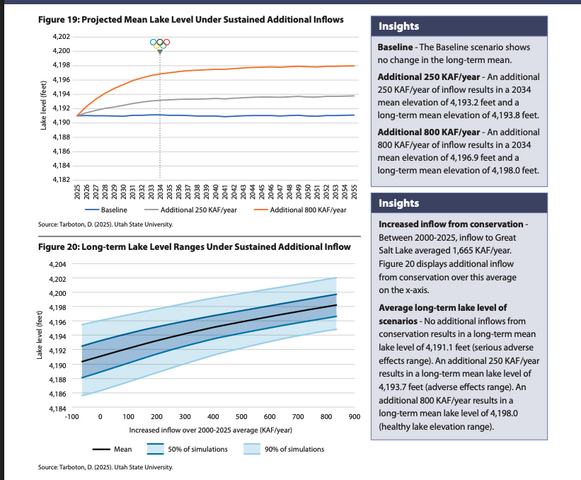
How do I know? The Great Salt Lake Strike team ran simulations: With an additional 250K a year, the lake would likely sit at a mean elevation of 4,193 by 2034, a level considered in the “adverse effects” zone. That would be 3 feet higher than today (which means we are in the “serious adverse effects” zone).
With an additional 800K acre feet of water a year, the lake could sit at a mean elevation of 4,197 feet by 2034, close to what’s historically been defined as healthy and 7 feet higher than today. Here’s a screenshot from the 2026 report:
Last year, the people around Cox immediately tried to walk back his elevation goal, noting that stopping the lake’s decline and slowly filling it would be success — something that additional 250K acre feet of water each year should do.
Freeze told me the goal of an additional 250K is a first step.
Something to watch: If the lake doesn’t reach 4,198 by the Olympics, will state leaders consider it “healthy”?
Here’s a snapshot of other health measures. Let me know what you think or what I’m missing.
Salinity:
This is considered a success story since salinity levels in Gilbert Bay sit at about 134 grams per liter today. That matters because salinity was much higher when the lake's elevation was at a similar point in 2022, imperiling brine shrimp, brine flies and the millions of migratory birds that rely on them.
Bird population:
A recent survey of birds at the lake found that compared with 30 years ago: “Shorebird populations declined by 36% during fall counts and 53% in spring counts, with American Avocets — one of Great Salt Lake’s iconic species — down by an average of 68%.” Like the Great Salt Lake, the other saline lakes and wetlands the birds rely on around the world are drying.
Wetlands:
I’ve asked the state how many acres of wetlands have been lost around the lake in the past couple of decades due to development and drought. A study is underway and is to be released next year.
Dust:
A recent study on the costs of dust to public health found that when the lake was 4,192 feet (it’s at 4,190 today) “lake bed dust is associated with roughly 6 deaths, 21 hospital admissions, 102 emergency department visits, 17,052 missed workdays, and 17,748 missed school days each year.”
It continued: “Higher lake levels reduce exposed dust-emitting surfaces, lower population exposure to dust, and greatly reduce health damages.”
— Heather May, Great Salt Lake Collaborative director