
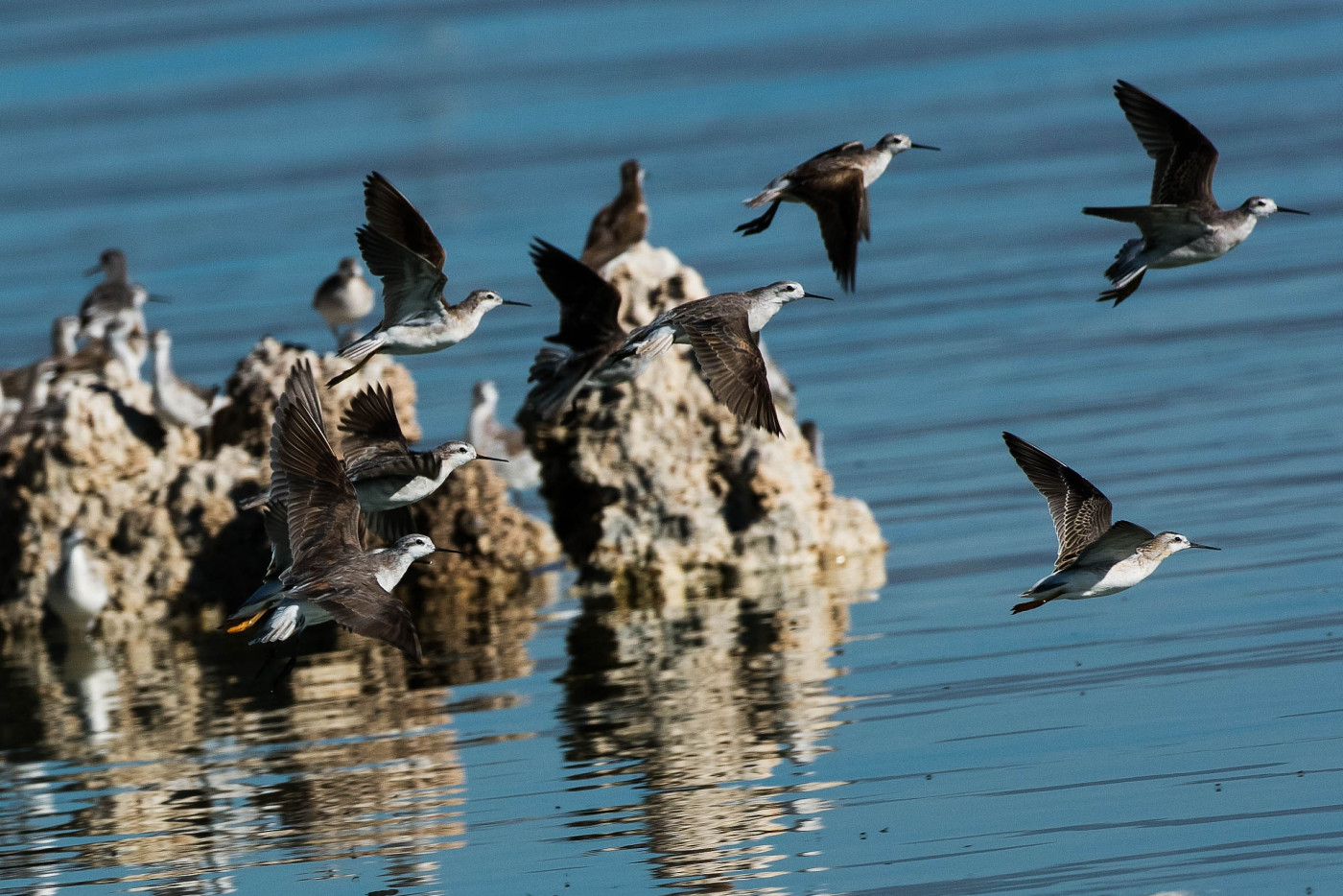
SALT LAKE CITY — The U.S. Fish and Wildlife Service has taken steps toward designating the Wilson's phalarope an endangered species.
"Based on our review, we find that the petitions to list... present substantial scientific or commercial information indicating that the petitioned actions may be warranted," the agency said in a notice shared with FOX 13 News by the environmental group that has petitioned for the designation.
The decision could present a nightmare scenario for state leaders on the Great Salt Lake. Environmentalists have pushed for an endangered species designation, arguing that state leaders simply have not done enough to save the lake and the millions of migratory birds that rely on it.
"This is such good news for people who love the lake, love the birds and loving breathing clean air," Deeda Seed of the Center for Biological Diversity, which supported the petition, told FOX 13 News. "Because it means we’re going to be taking steps to solve these problems with the pressure that comes from the Endangered Species Act and that’s good."
An endangered species designation opens the door to immense federal oversight of plans to reverse the lake's declines. It has been opposed by political leaders on Utah's Capitol Hill.
"If any species of wildlife gets listed, we lose that control so we’re going to do everything we can to make sure we don’t lose that control of what happens on the Great Salt Lake," said Sen. Scott Sandall, R-Tremonton. "We can manage it better than the federal government can."
The decision does not mean an endangered species designation will happen. What it means is the federal government is "initiating status reviews of these species to determine whether the petitioned actions are warranted."
"...we find that the petition presents substantial scientific or commercial information indicating that listing the Wilson’s phalarope as a threatened or endangered species may be warranted. The petition also presented information suggesting that wintering habitat loss from lithium mining, general habitat loss under climate change, and reduced salinity following wetland restoration projects may be threats to Wilson’s phalarope," the agency said in its notice.
Senate Republican leaders defended their work to save the Great Salt Lake, noting numerous bills on conservation and ensuring water gets to the lake.
"I think every piece of legislation we do is directed towards that, but beyond that there’s a heavenly force that’s going to dictate how much water goes into that lake in huge volumes," Sen. Sandall said. "We can do our part and continue to do our part."
Senate Minority Leader Luz Escamilla, D-Salt Lake City, said there is an urgency of saving the lake.
"If the Great Salt Lake continues to deplete at this level? We can’t even be here. The fugitive dust that’s coming out of that place is toxic. The public health implications and wildlife, which we’re all committed to protecting, needs to be at the forefront of everything we do in this state," she told reporters on Friday.
Seed, who is among those suing the state over its handling of the Great Salt Lake, said political leaders aren't doing enough to ensure water is getting into the lake.
"The prescription is to get water to the lake, to save the birds, to save the health of the population in northern Utah," she said. "These are all good things that come out of solving this problem."