As Gov. Spencer Cox pledges to fill the Great Salt Lake by Utah’s 2034 Olympic Games, conservation advocates question the plan’s feasibility based on current efforts
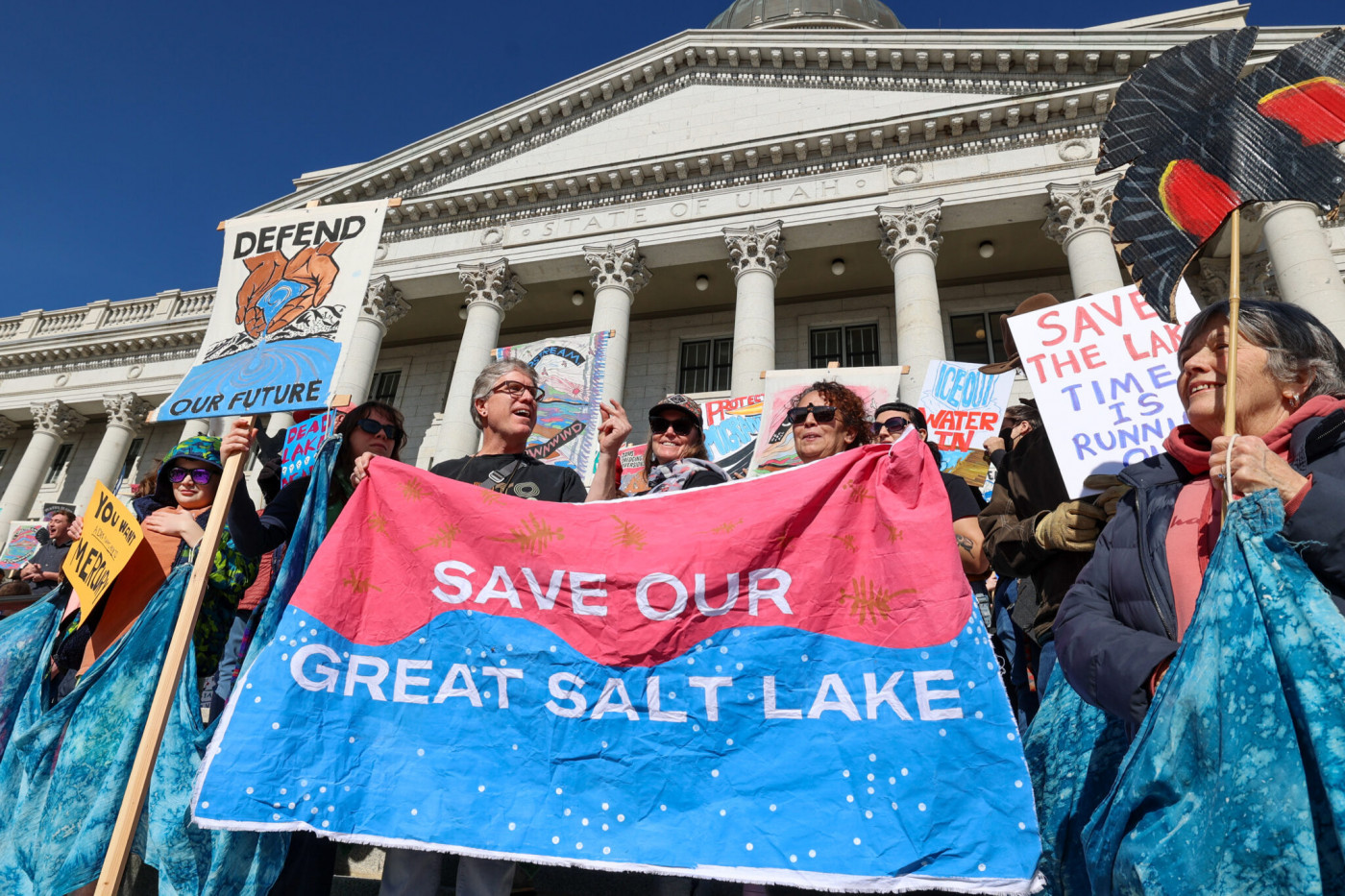
At the 5th annual “Rally to Save Our Great Salt Lake,” hundreds of Utahns gathered in Salt Lake City to celebrate water conservation work while also questioning whether the state’s efforts are enough to meet Gov. Spencer Cox’s recent pledge to fill the ailing lake by 2034.
Last year, the lake dropped to its third-lowest level on record, as public health professionals continue to warn against the health risks of a shrinking Great Salt Lake, which include exposure to toxic arsenic dust from the dry lakebed and worsening air quality.
“This is our fifth year, and the rally has become an opportunity to show our lawmakers and decision-makers that we the people care about Great Salt Lake,” said Chandler Rosenberg, co-founder and board member of Save Our Great Salt Lake, one of the groups organizing the rally.
Utah’s top natural resources officials are calling 2026 a “watershed year,” along with Gov. Cox’s pledge to fill the Great Salt Lake by 2034 in preparation for Utah’s Olympic games. Rosenberg emphasized that, while progress is being made, the job is far from finished and conservation efforts must increase.
“It’s a human rights issue, it’s a health issue … we need water in the lake to prevent toxic dust from blowing into the valley and worsening our air shed.” Rosenberg added. “The shrinking Great Salt Lake poses a huge threat to our health, to our economy, to the precious ecosystem out there, and we felt like it was really important to spread the word.”
She emphasized that the rally, while centered around restoring the Great Salt Lake, also touches on a “wide range of messages,” from political demonstrations to celebrating conservation work.
“This is about the lake, but we also want to show people that we are here for all sorts of other causes, and the lake is not just an environmental issue,” she said. “It’s also for us to gather and celebrate the hard work we do all year long. We’ve got the costumes, the songs, and it’s become a pillar of our community here in Salt Lake.”
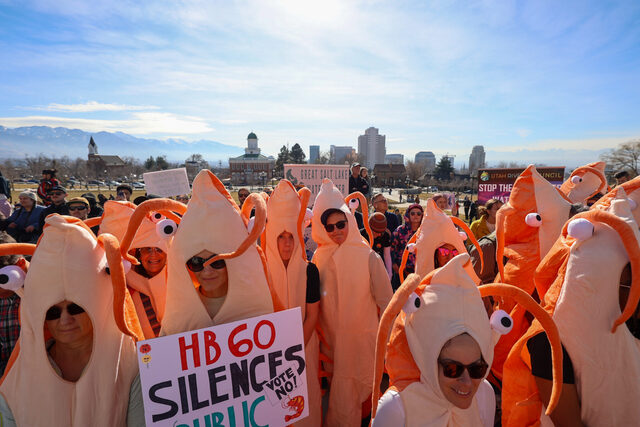
Demonstrators dressed as brine shrimp call for action to save the drying Great Salt Lake in a rally at the Utah State Capitol on Saturday, Jan. 31, 2026. (Will Ruzanski/Utah News Dispatch)
Utah water policy
Jake Dreyfous, managing director of Grow the Flow, a nonpartisan conservation advocacy nonprofit, said that saving the Great Salt Lake is not a political issue among Utah’s lawmakers.
“As far as the policymaking goes, we’ve seen leadership from our Republican legislators and our Democrat legislators alike pushing for sound and sustainable policy to see more water in the lake,” he said. “The sale of U.S. Magnesium is a huge win, that’s 40- to 60,000 acre-feet of new water that’s going to be in the lake every single year in perpetuity.”
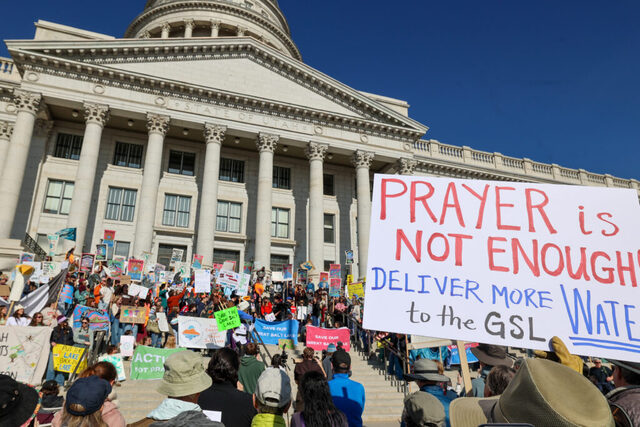
Demonstrators call for action to save the drying Great Salt Lake in a rally at the Utah State Capitol on Saturday, Jan. 31, 2026. (Will Ruzanski/Utah News Dispatch)
Pending Utah’s $30 million acquisition of U.S. Magnesium — a bankrupt mineral extraction plant near the Great Salt Lake’s shores — lawmakers are planning to send more of its water to the Great Salt Lake. Dreyfous said the plan is just another piece of a larger puzzle, emphasizing the need for more water conservation efforts.
“We need about a million acre-feet of more water every single year if we want to see the lake restored by 2034,” he said. “We want to conserve water upstream and grow the flow of water moving into the lake.”
Others were more critical of the state’s conservation efforts. Brandi O’Brian, programs and development manager for Utah Physicians for a Healthy Environment — the state’s largest civic organization of health care professionals focused on public health and the environment — said “we need a lot more from the legislature.”
“We can’t save the lake if we’re cutting off the wetlands with developments from the Utah Inland Port Authority,” she said. “We can’t save the lake if we continue spraying toxic pesticides across it.”
Public health and the lake
Referencing a report released by Utah Physicians for a Healthy Environment in November, O’Brian emphasized the lake has already reached dangerously low levels, saying “the health of everybody in the valley is threatened already, so it’s a very urgent situation.”
The report, “Downwind: How Failed Great Salt Lake Water Policy and Toxic Dust Create Generational Debt and Jeopardize Utah’s Future,” shows that the “lake level continuing to drop could cost the state billions between controlling dust and dealing with health issues of residents.”
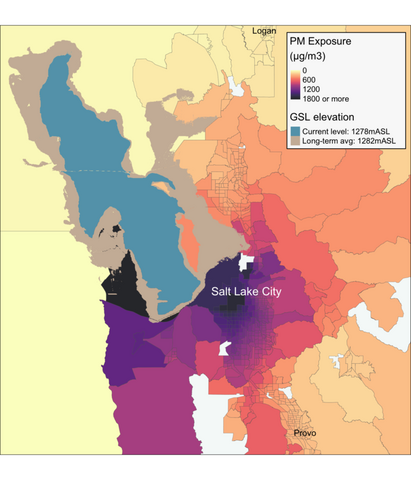
A map depicting dust exposure from the Great Salt Lake. (Dr. Albert Garcia)
It emphasizes that there is still time to mitigate the problem, but “there is only one viable dust-mitigation solution: restore Great Salt Lake’s surface area to 1,600 square miles. Utah’s future depends on it.”
Alta Fairbourne, community water organizer for Utah Rivers Council, a nonprofit conservation group working to protect Utah’s waterways, emphasized that the Great Salt Lake is an ecological backbone of the Wasatch Front.
“If we don’t conserve nature and our natural resources, we can’t conserve our future, health or well-being,” she said. “Conservation is literally life.”
An environmental health program report from the U.S. Geological Survey found that the shrinking Great Salt Lake exposes dust laden with heavy metals and chemical pollutants, posing severe inhalation hazards. As the Salt Lake Valley’s poor air quality already presents severe long-term health risks, the USGS report warns shrinking lake levels will worsen the quality of air, potentially leading to “developmental issues and long-term health problems” in adolescents.
Youth advocacy
Demonstrators at the rally covered a broad spectrum, ranging from schoolchildren to the elderly. Franque Bains, director of the Sierra Club’s Utah chapter, a grassroots environmental advocacy group, emphasized the importance of youth advocacy for conservation.
“The youth are our future, and their role is to really help us put pressure,” she said. “They’re going to be the ones who are here decades after we pass, and so we really, really support their voice.”
She referenced the intergenerational advocacy movement throughout the Sierra Club.
“There may be perceptions or information that our elders haven’t been as active, but that’s just absolutely not true,” she added. “They want by 2034 for us to have the Olympics here, my reaction is, let’s work hard, we’ve got coalitions, we have the Governor’s support, let’s direct water to the Great Salt Lake.”
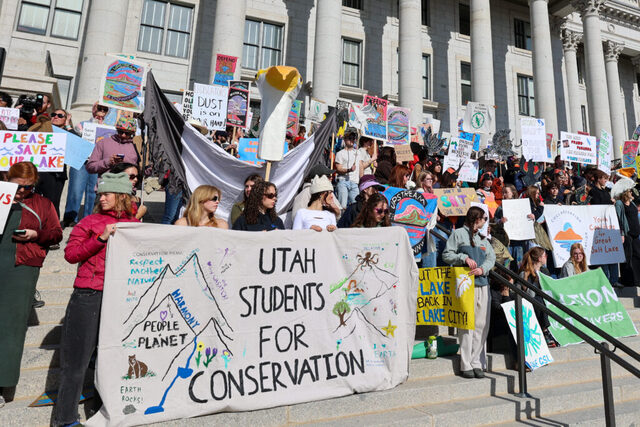
Demonstrators call for action to save the drying Great Salt Lake in a rally at the Utah State Capitol on Saturday, Jan. 31, 2026. (Will Ruzanski/Utah News Dispatch)
Katie Newburn with Friends of Great Salt Lake, a nonprofit dedicated to preserving the Great Salt Lake ecosystem through education, research, advocacy and the arts, said that “youth voices are so critical and so effective” for conservation.
“I manage our fourth-grade field trip program that brings about 3,000 students from around the watershed out to Antelope Island and Great Salt Lake State Park each year,” she said. “They have this hands-on experience wading into the lake, catching brine shrimp, learning about how they’re connected to the lake and how upstream water consumption affects what lives downstream,” she said.
Newburn recalled the first group of fourth graders her organization took to the Great Salt Lake in 2004.
“I like to think those kids are some of the advocates who are showing up here now as decision-makers,” she said. “I think giving them that personal, hands on connection is a big part of carrying that advocacy with them through their lives”
She recommended people “go out and visit” the lake, saying “your connection with the lake is one of the most motivating parts of being an advocate for it.”
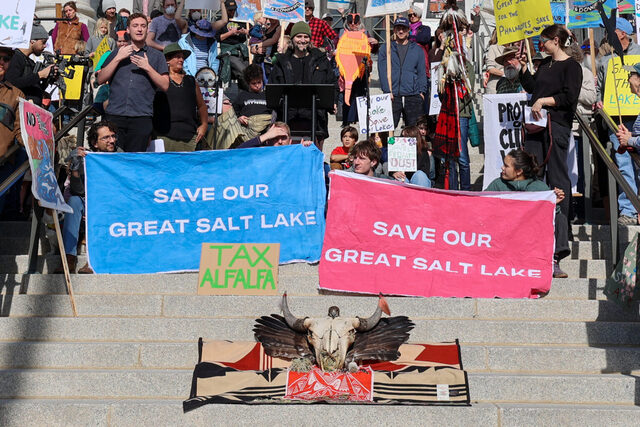
Demonstrators call for action to save the drying Great Salt Lake in a rally at the Utah State Capitol on Saturday, Jan. 31, 2026. (Will Ruzanski/Utah News Dispatch)