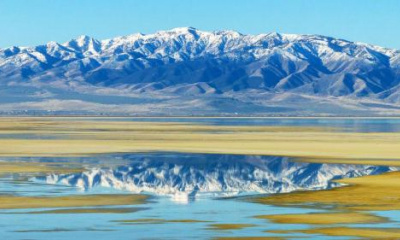

SALT LAKE CITY — A new online tool from the University of Utah shows how much dust from the shrinking Great Salt Lake is impacting northern Utah neighborhoods.
The Great Salt Lake Basin Dust Exposure Modeling Tool is free to use and allows users to adjust water levels to see how dust spreads across the region.
“In the past, we’ve only had several air quality sensors, and … they don’t well represent the Salt Lake Valley in the sense that, we had one air quality sensor up in Rose Park, one that is down in Sugar House. But there’s large data gaps, such as like Sandy or maybe the western side of the Salt Lake Valley, like West Valley,” model co-creator Derek Mallia said. “There aren’t that many measurements. So how do you measure dust exposure when you don’t have data?”
He used data for dust storms in spring of 2022 for the model, but that will soon extend to include the years 2018 through 2023.
“The new updated results will not change things a whole lot,” Mallia said. “We see the same gradients in dust that that we see right now with just 2022. So this tells us that 2022 is pretty representative of the dust storms that we see.”
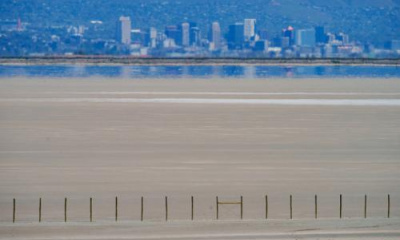
Researchers said the lower the lake’s water levels, the more dust is released into the air.
“Getting the lake levels up higher just means that … less shoreline will be exposed with the water covering it, and so fundamentally, just has to result in less dust,” Mallia said.
The dust isn’t just bad for our health. Mallia said it’s bad for Utah’s snowpack.
“Based on some projections by our dust modeling tool … that snow melt could be accelerating, as much as two to three weeks due to the dust depositing on the snow,” he said.
“What that does is it darkens the snow and then allows the snow to basically absorb more energy from the sun. And then basically it will melt faster.”
It’s not just the mountains. The west side of the Salt Lake Valley typically experiences higher dust exposure, Mallia said.
“Dust on its own, even if it’s just mineral dust, you can breathe it in and it can deposit really deep into your lungs, which means it can get into your bloodstream,” he said.
Not all dust comes from the Great Salt Lake. The model also accounts for dust from other lakes and the West Desert.
This story was adapted from a TV broadcast script using artificial intelligence. Every story, including those adapted with AI, is reviewed by a human editor before publication to ensure that KSL’s editorial standards are upheld.