
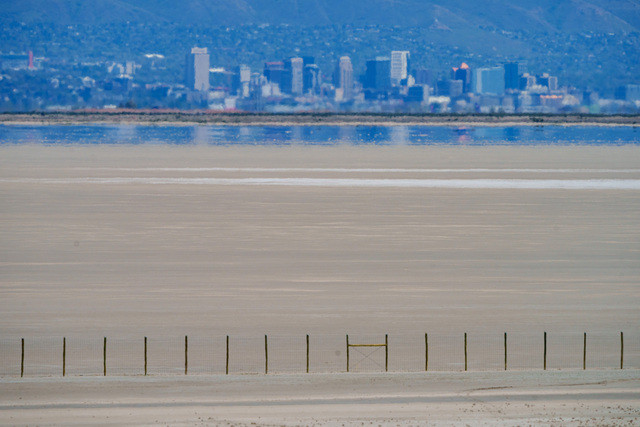
Report highlights potential engineered solutions for keeping dust down over the many years it will take the lake to refill.
Despite the Great Salt Lake’s dire straits, state researchers and leaders remain optimistic that Utah will become the first place in the world to reverse a saline lake’s decline — and do so in time for the 2034 Winter Olympics.
The Great Salt Lake Strike Team released its annual report Wednesday, just weeks ahead of the 2026 legislative session. Cities are contributing to the lake’s decline more than previously thought, the team found. Farmers have increased the amount of water leased to help the lake rise again, although policymakers acknowledge more work needs to be done. In the meantime, state leaders are exploring ways to channel more water to the Great Salt Lake and suppress its toxic dust.
Above all, this year’s report highlights the fact that every water user in the lake’s watershed has a role to play in reversing its decline, said Great Salt Lake Commissioner Brian Steed.
“Humans do have an impact on this lake, and yes, our choices do matter,” Steed said during a presentation at the Kem C. Gardner Policy Institute summarizing the findings.
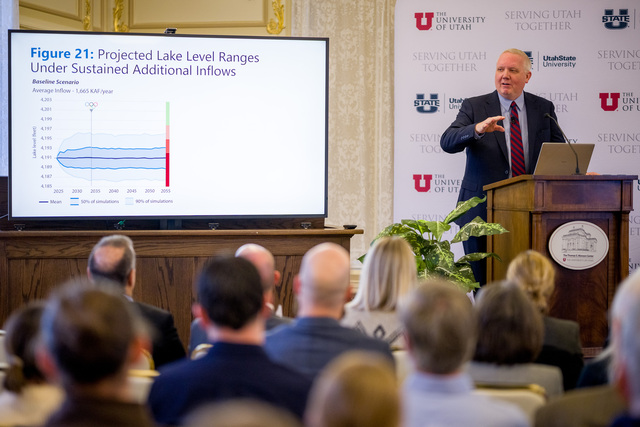
(Trent Nelson | The Salt Lake Tribune) Great Salt Lake Commissioner Brian Steed as the Great Salt Lake Strike Team members and state legislators discuss efforts to save the lake, in Salt Lake City on Wednesday, Jan. 7, 2026.
The strike team is a group of researchers from Utah’s public universities and state agencies that provide non-partisan data on the lake and policy ideas without advocating for any particular solution.
The Great Salt Lake hit a record low in late 2022, causing lawmakers to scramble for fixes and reform the state’s water law.
“Now we’re still dealing with climate trends and precipitation trends that have pushed back against where that lake level is and where we want to go,” said Rep. Casey Snider, R-Paradise, “but we’re still committed, long term, to making a difference.”
Farmers in the lake’s watershed have expressed frustration, however, worrying they’ve become a scapegoat for the lake’s decline. They say they’ve made significant changes and invested in more efficient irrigation while urban-dwellers haven’t been subject to the same scrutiny.
The strike team’s latest research indicates cities may, indeed, use more of the water that would otherwise flow to the Great Salt Lake than previously calculated.
As recently as last year, the team estimated municipal and industrial users depleted just under 17% of the water in the Great Salt Lake Basin. But the 2026 report found those uses now account for almost 27% of depletions.
“As our population grows, as we build more homes,” said Joel Ferry, director of the Department of Natural Resources, “... it’s becoming a more and more significant portion of the water that we consume.”
While Utah’s population has grown, leading to more municipal water consumption, the volume of water used per resident has mostly declined since 1989. The amount of water Utahns use indoors has remained relatively flat over that period, as well, meaning the bulk of increased municipal use happens outdoors, on lawns and gardens.
“You can no longer say, ‘well, it’s those [farmers’] problem. It’s their fault,’” said Snider, the House majority leader. “It’s really an us problem now.”
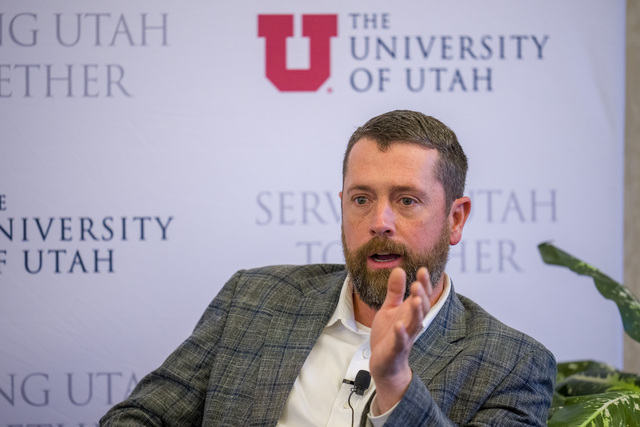
(Trent Nelson | The Salt Lake Tribune) House Majority Leader Casey Snider, R-Paradise, as the Great Salt Lake Strike Team members and state legislators discuss efforts to save the lake, in Salt Lake City on Wednesday, Jan. 7, 2026.
The latest strike team report lauded significant funds flowing to the Great Salt Lake’s recovery. Last year alone brought $50 million from the federal government, $100 million from the conservation nonprofit Ducks Unlimited and another $100 million from the private sector through the Great Salt Lake Rising initiative.
Funds dedicated to the Great Salt Lake help with wetland and habitat improvements. Those dollars are also used to lease water from farmers and other water right holders.
Last year, state resource managers and their partners secured 163,468 acre-feet for the lake, up from roughly 18,000 acre-feet in 2021, when the program began.
But last year’s leased water remains a puddle in the context of the lake’s shortages. Strike Team modeling shows the Great Salt Lake will need at least 800,000 additional acre-feet per year to have even a 47% chance of reaching a minimum healthy elevation in time for the 2034 Olympics.
Despite new findings on urban water use, agriculture still consumes the bulk of the water in the Great Salt Lake’s basin. Farming accounts for just under 65% of depletions according to the latest estimates.
Strike team members and state leaders acknowledged attempts to build a robust leasing network, mostly from agricultural irrigators, haven’t moved as quickly as some Utahns hoped.
“The volume of water we need is a huge amount, [and] it’s very expensive,” Ferry said.
Efforts are underway to streamline the leasing program, state officials added, and to better track every molecule of water so lessors and the state can confirm it reaches the lake.
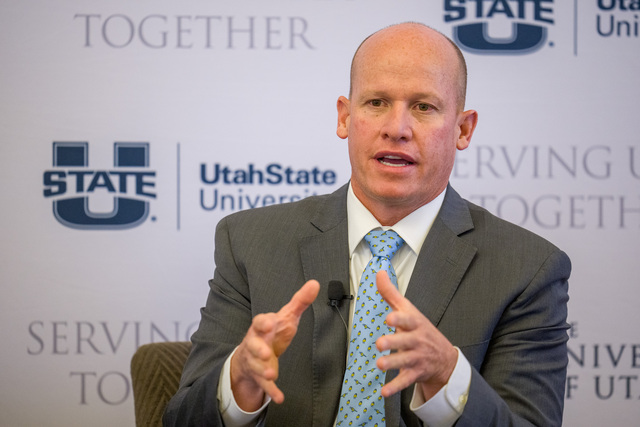
(Trent Nelson | The Salt Lake Tribune) Joel Ferry, director of Utah Department of Natural Resources and the state's water agent, as the Great Salt Lake Strike Team members and state legislators discuss efforts to save the lake, in Salt Lake City on Wednesday, Jan. 7, 2026.
“We have learned in the last several years what has worked and what has not worked in this space,” Snider said. “We are being responsive to that.”
Researchers and analysts have floated the idea of encouraging Utah farmers to switch to less water-intensive crops, such as wheat instead of alfalfa.
But Deputy Great Salt Lake Commissioner Hannah Freeze said economic forces make that difficult, noting that new crops often require costly investments and face uncertain market demand.
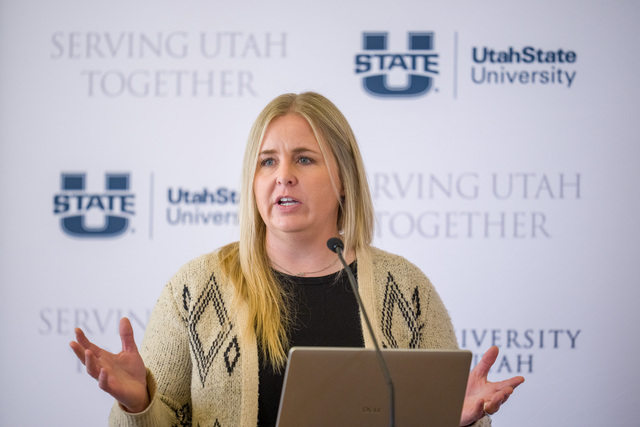
(Trent Nelson | The Salt Lake Tribune) Hannah Freeze speaks as the Great Salt Lake Strike Team members and state legislators discuss efforts to save the lake, in Salt Lake City on Wednesday, Jan. 7, 2026.
Resource managers are working with farmers to help them look at water as another commodity they can offer up for sale, much like crops, Freeze said. The state is paying those farmers to fallow parts of their fields at a rate of around $300 per acre, depending on the farm’s location in the watershed.
“We’re making strides in engaging with our agricultural producers,” Freeze said, “and we’re making good efforts to develop these water markets.”
Team floats new solutions as Utah awaits lake’s recovery
Gov. Spencer Cox and other state leaders have made Great Salt Lake recovery in time for the Winter Games a priority. The governor signed a charter in September underscoring the commitment.
Utah now has less than a decade to get there, and the Great Salt Lake currently teeters only a few feet above its historic low.
Its major population center on the Wasatch Front is already grappling with dust storms from the lake’s drying lakebed. More than 800 square miles sit exposed.
The Department of Environmental Quality is in the process of installing a monitoring network to better understand the extent of the air pollution problem blowing from the lake and other dust sources across the state. The Great Salt Lake Commissioner’s Office chipped in $1 million to help fund the effort when appropriations from lawmakers last year fell short.
“This is the first time that the state has really taken the dust issue seriously,” said Kevin Perry, a strike team member and professor of Atmospheric Sciences at the University of Utah.

(Trent Nelson | The Salt Lake Tribune) Kevin Perry speaks as the Great Salt Lake Strike Team members and state legislators discuss efforts to save the lake, in Salt Lake City on Wednesday, Jan. 7, 2026.
In the meantime, as state officials wait for the Great Salt Lake to refill, the strike team is exploring engineered solutions to protect public health.
One proposal floats diking off Farmington Bay so it can flood for at least part of the year, keeping 21 square miles of dust hot spots near population centers in Davis and Salt Lake counties wet.
The proposal comes with tradeoffs, however. A shallow impoundment in Farmington Bay could speed evaporation compared with allowing the water to naturally flow to the main body of the lake. It could also spike salinity and impact brine flies and brine shrimp, lowering the rest of the lake by up to two feet.
The strike team report also explored moving water from the Newfoundland Basin to the Great Salt Lake. The formation in the west desert accumulates natural inflows up to 50,000 acre-feet per year. State resource managers previously pumped water out of the Great Salt Lake into the Newfoundland Basin to mitigate unprecedented flooding in the 1980s. The latest proposal would do the reverse.
But the precipitation that basin collects varies year to year, and it spreads out over a large geographic area.
“Some years you’ll get almost none,” said Bethany Neilson, director of the Utah Water Research Laboratory at Utah State University, “and some years you get quite a bit.”
(Trent Nelson | The Salt Lake Tribune) Beth Neilson speaks as the Great Salt Lake Strike Team members and state legislators discuss efforts to save the lake, in Salt Lake City on Wednesday, Jan. 7, 2026.
That makes the basin’s water difficult to recover and an unreliable source of ongoing water for the Great Salt Lake.
Even more proposals for tamping down lakebed dust will get attention in another report due later this month, Perry said. The professor identified at least 12 ideas that proved successful at Owens Lake, a smaller but similar saline lake in rural California that dried to a dusty salt pan due to overconsumption in Los Angeles.
Those solutions ranged from shallow flooding and planting vegetation to armoring the surface with materials like gravel or mulch.
“There’s no one technique for dust mitigation that works equally well over the entire lake bed," Perry said, adding that “engineered dust control solutions can be very expensive, rising to the billions of dollars.”
Human ingenuity saved the Great Salt Lake from collapse at least once in recent years. Resource managers with the Department of Natural Resources filled in a breach in the rock-filled railroad causeway that bisects the lake as it continually hit record lows in late 2022.
The move turned the north arm into a salt sink and kept salinity from spiking in the more productive south arm. It also kept brine shrimp and brine fly populations from crashing, saving millions of migrating birds and a multi-million dollar aquaculture industry.
The department said it will likely fill in the causeway once again as a lackluster start to the water year has taken a toll on lake levels once again.
Note to readers • This story is made possible through a partnership between The Salt Lake Tribune and Grist, a nonprofit environmental media organization.