
What will it mean to “MAKE ‘THE LAKE’ GREAT AGAIN!”?
That’s what President Donald J. Trump says he wants to do, in a post on his Truth Social social media platform recently after meeting with Utah Gov. Spencer Cox.
Cox told reporters he asked for $1 billion and that a pitch for the money will be forthcoming. And a new resolution just released for debate by Republican lawmakers at the Utah Legislature calls for urging the federal government to “provide substantial and timely assistance dedicated to stabilizing and restoring the Great Salt Lake.”
There’s talk of funding conservation projects, pipelines to bring in water, and building desalination plants in California in exchange for Colorado River water. (The Colorado River and Great Salt Lake are connected: Water from the river makes its way to the Wasatch Front via the Central Utah Project.)
I asked several local organizations that have been working on saving the Great Salt Lake what they make of the news. Nine responded, representing youth, farmers, scientists, business leaders, organizers and environmentalists.
Below are their unedited statements in alphabetical order. I asked them to write about best and worst-case scenarios of him getting involved; what the money should be spent on and what role should the feds play in getting more water to the lake:
Center for Biological Diversity
“Great Salt Lake is on the brink of another all-time low, with the risk of ecological collapse that brings. Where will we be in October 2026? Getting water to the lake is the most important thing we can do.
“In the midst of the crisis, Utah’s leaders focused President Trump’s attention for a moment on Great Salt Lake, but it’s unclear what this means. There’s an important role for the federal government in helping to save the lake, and among other things, that should come in the form of money to buy water for the lake. But there’s also the risk that federal resources are directed toward actions that don’t help the lake, but do help speculators, such as pie in sky schemes that involve taxpayer subsidies for projects to acquire water from “somewhere else” or that invoke some unproven technological solution.
“We don’t need to pipe in water from somewhere else, nor is that practical; we need to live within our means and redirect existing water resources to Great Salt Lake. Hundreds of thousands of Wilson’s phalaropes, along with millions of other birds depending on Great Salt Lake can not afford to wait.”
— Deeda Seed, senior Utah campaigner of Center for Biological Diversity
FRIENDS of Great Salt Lake

(Courtesy photo | Lynn de Freitas, executive director of FRIENDS of Great Salt Lake)
“None of us know what the President's announcement really means for the Lake, but of course we welcome his support. We agree with the Governor's observation that the effort to save the lake transcends politics — that this is a bipartisan issue that needs bipartisan solutions.
“Regardless of our political beliefs, we all share the same goal of restoring the lake to a healthy level by 2034. As for any potential federal funding, and what that should be spent on, it's probably best not to get ahead of ourselves here.
“That said, we're fully confident that whatever additional funding comes our way will be put to good use by the amazing, dedicated people who are working tirelessly to find workable solutions to this problem.”
— Lynn de Freitas, executive director of FRIENDS of Great Salt Lake
Great Salt Lake Alliance
“President Donald Trump’s interest in helping the Great Salt Lake signals a clear shift: what was once viewed as a regional challenge is now recognized as a national one. Utahns have long understood that the Great Salt Lake is irreplaceable; federal recognition affirms that its future matters far beyond state lines. This expanded attention validates both the scale and urgency of the crisis—and creates a timely opportunity for leadership, clarity, and action.
“While no single investment will solve the lake’s challenges overnight, smart and visible investments can accelerate progress, align partners, and turn national attention into lasting results. Federal resources should remain focused on a shared goal — getting more water into the lake — by strengthening proven efforts already underway in Utah and ensuring the issue remains solutions-focused rather than politicized.
“The federal role should be to act as a catalyst, not a replacement for local leadership: supporting state and local efforts already in motion while aligning resources, science, and incentives to reduce ongoing water loss driven by systemic inefficiencies and a status quo that no longer works.”
— Lindsie Smith, executive director of the Great Salt Lake Alliance
Great Salt Lake Institute at Westminster University
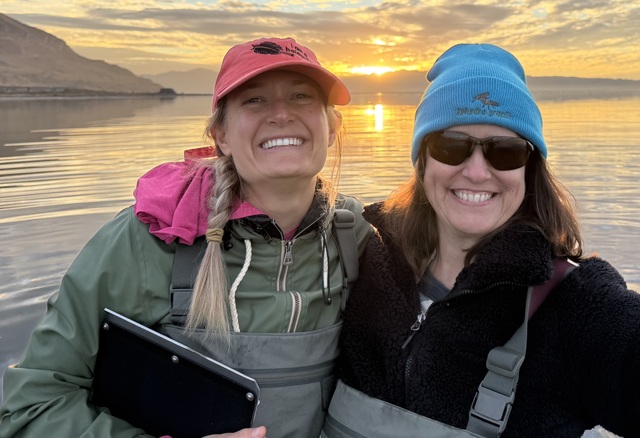
(Courtesy photo | Georgie Corkery, coordinator, and Bonnie Baxter, director, of the Great Salt Lake Institute)
“Any national attention on Great Salt Lake reflects the growing recognition that the lake’s decline is both an environmental and economic emergency. We welcome support from leaders at every level of government. The effort to protect and restore the lake transcends politics and requires durable, bipartisan solutions grounded in sound science.
“The lake’s primary challenge is reduced inflow combined with rising temperatures. Therefore, the most effective federal role is to support policies and investments that reduce water consumption, improve watershed management, and address climate-driven impacts. If significant federal funding becomes available, it should prioritize ongoing efforts that are proven to increase inflows to the lake: agricultural and municipal water conservation, secondary water metering, water optimization projects, invasive species management, and contributing to the Great Salt Lake Water Enhancement Trust to secure water flowing to the lake.
“We should avoid funding risky efforts with little science to back them up. For example, cloud seeding to increase precipitation over saline lakes has not resulted in the desired outcome. Until we see positive results from trials, we should not invest.
“Moving water through pipelines is possible; we know this because we move liquid petroleum all over our country. But it’s terribly expensive. The time involved in building the infrastructure for piping over mountains then desalinizing combined with the costs might rule this out.”
— Bonnie Baxter, director, and Georgie Corkery, coordinator, of the Great Salt Lake Institute
Great Salt Lake Policy Project at the University of Utah law school
“If President Trump wants to help save Great Salt Lake, his best pathway is to line up federal funding for the rescue effort. Media reports suggest that Governor Cox and the President discussed $1 billion in funding to make the lake great again. If we get the money, here is how to make the biggest difference:
“Most of the money should be used to lease and buy water to help refill and sustain the lake. This includes buying water from rightsholders outside of Utah along the Bear River in Idaho and Wyoming, assuming that the President secures the cooperation of these neighboring states.”
— Brigham Daniels, director, and Beth Parker, associate director of the Great Salt Lake Policy Project
Grow the Flow
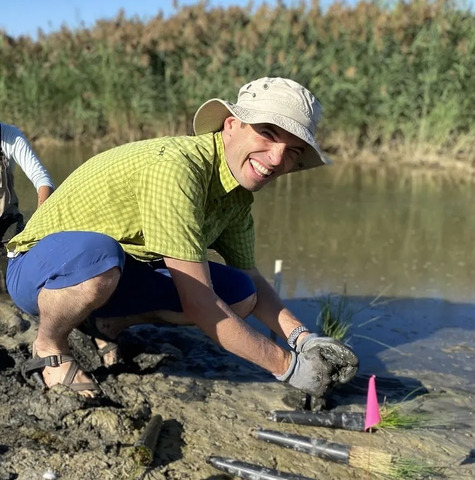
(Courtesy photo | Ben Abbott, executive director of Grow the Flow)
“Grow the Flow is grateful for President Trump’s support for Great Salt Lake, and is heartened by the president’s understanding of its national importance.
“Saving Great Salt Lake is an American problem. Fertilizers and minerals from the lake support American farming and industry. The Great Salt Lake contributes to a multi-billion economy and impacts air quality for millions of Americans.
“Thinking of the division in our country right now, we need a win. If we succeed in being the first country to restore a saline lake, this will lead to more rain and snow, cleaner air, more fertile fields, and a stronger community.
“Because the lake's tributaries flow through four states, federal coordination and funding are urgently needed. The President's and Governor's public leadership on this issue could lead to investments for sustainable, cost effective, and proven solutions.
“The state of Utah has shown that it can work with farmers and cities to conserve water and deliver that water to the lake. Now we need funding to expand these programs to grow the flow of water to the lake. The Governor's ask of a billion in federal funds would be a huge step in the right direction.
“We are eager to work with state and federal governments to implement proven and economical solutions that align with Utah’s values of stewardship, hard work, and living within our means.”
— Ben Abbott, executive director of Grow the Flow
Stewardship Utah
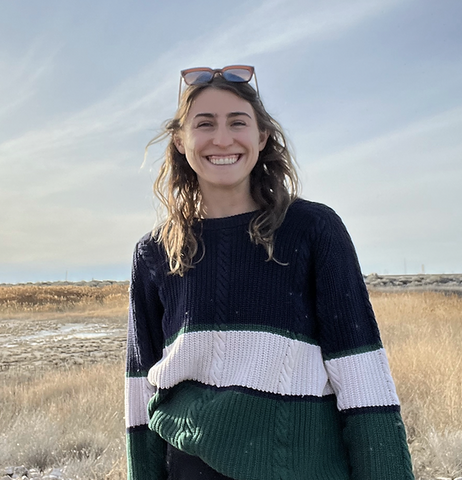
Courtesy photo | Chandler Rosenberg, Great Salt Lake policy associate at Stewardship Utah)
“Trump’s recent GSL statement is encouraging. Plan or no plan — at the very least, the attention helps and the affirmation that this is indeed a nonpartisan issue creates a friendlier environment for state-level action. This issue is monumental and we need everyone.
“I’d love to see Trump’s statement turn into funding to support serious statewide conservation and transition agricultural production. We need robust conservation in every sector. Funding could provide stronger incentives for conservation programs and water-efficient landscaping, support municipalities in the basin to hire water conservation staff, while also perhaps offering a support buffer for water suppliers to transition away from property-tax subsidized pricing models that disincentivize conservation.
“Federal support could drive significant change on the agricultural front — accelerating water leasing, supporting more efficient irrigation (contingent on dedications to the lake) and investing seriously into alternative crops and the development of alternative markets.
“GSL is a complex, systemic problem, and solid “solutions” require thoughtful dialogue and strategic convening with diverse stakeholders in new ways. I’d love to see funding dedicated to improved collaboration and coordination through increased staff capacity, strategic forums (perhaps staffing GSL-basin watershed councils), as well as creative and robust messaging.
“I’m concerned that instead of prioritizing conservation — the cheapest way to increase flows to GSL — there will be an overemphasis on technoindustrial fixes like additional pipelines and cloud seeding that don’t address the roots of the crisis. My hope is that federal involvement wouldn’t soften pressure on state leaders to make hard decisions and dedicate ongoing long-term funding.”
— Chandler Rosenberg, Great Salt Lake policy associate at Stewardship Utah
Utah Farm Bureau Federation
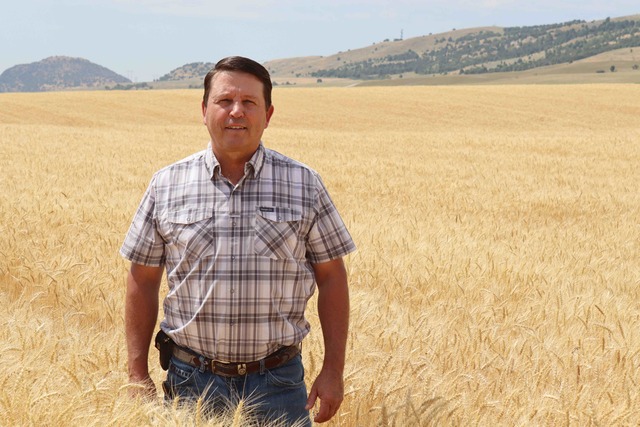
(Courtesy photo | ValJay Rigby, president of the Utah Farm Bureau Federation)
“It is a little difficult to fully evaluate what participation from the federal level means because we haven’t really heard or seen any details. But we appreciate that Governor Cox has had conversations with President Trump about the importance of the lake. Having it mentioned by the President shows the commitment by the State of Utah and by farmers and ranchers in Utah to be wise stewards of water, and that we’re taking this seriously. We also appreciate that Governor Cox has highlighted the value and importance of local agriculture — and that helping the lake and keeping agriculture thriving are not mutually exclusive.
“We believe the best-case scenario is that President Trump commits federal funding and other resources, such as Bureau of Reclamation expertise and facilities, and tools available through NRCS [Natural Resources Conservation Service], NOAA [National Oceanic and Atmospheric Administration], NASA, etc., to the benefit of the lake, while leaving management of restoration efforts to local and state expertise. We would also hope for improved watershed management by the U.S. Forest Service, Bureau of Land Management, and other land agencies for the present and future benefit of the Great Salt Lake.
“We have started to see strong traction from efforts underway in the state. We would hate to see any momentum stalled due to new partners getting involved or implementing efforts that are not science-based.
“If there is federal assistance, we would love to see increased investment in voluntary water demand reduction programs such as the Ag Water Optimization program, and better control of invasive species that intercept water supplies to the Great Salt Lake, such as phragmites, tamarisk, and kochia. Lastly, we would love to see greater investment in water optimization research at our Land Grant University, Utah State University. This could have implications for national food security beyond Utah, as many food-producing areas throughout the United States are currently water-stressed.
“Finally, we would love to see federal assistance in developing incentives for additional voluntary water demand reduction programs in Idaho and Wyoming, both of which use water from the Bear River that could also be going toward the Great Salt Lake.”
— ValJay Rigby, president president of the Utah Farm Bureau Federation
Youth Coalition for Great Salt Lake
“We are very pleased about the national attention and public exposure to this far reaching issue. This could aid us in our cultural change and funding to save the lake. Best case scenario, the federal government could help half of or more Utahns replace their grass lawns with native plants. That’d already be a lot of water saved, but we need more. We need funding for our farmers so they can work towards higher water savings.
“And while so much could go right, we have fears. We worry this statement was more for publicity than genuine desire to help. We must hold our government officials accountable for what they promise, and the information they announce. Trump has a track record of spreading misinformation and openly going against science, that could lead to problematic outcomes if he is to speak about the lake and be the main source of information for many. He has already described the issue as a “natural disaster." It is not. The lake levels are declining because of our existence here. The water we use as Utahns comes from the rivers that feed Great Salt Lake. As a result, the lake receives less than ⅓ of its natural streamflow. About 90% of municipal water use is outdoors on grass. This is why water conservation is the cheapest option Utah can take to save Great Salt Lake.
“Overall, the announcement is a great start, and we are optimistic. We know, however, that this is only the beginning. The public must keep this momentum for a culture that values its more-than-human world. We must keep watching and pressuring our government to save Great Salt Lake.”
— India Elliott, head of information for Youth Coalition for Great Salt Lake