
The Great Salt Lake’s shrinking shoreline has become one of Utah’s most pressing environmental concerns, but for some residents, waiting for someone else to solve the problem isn’t an option.
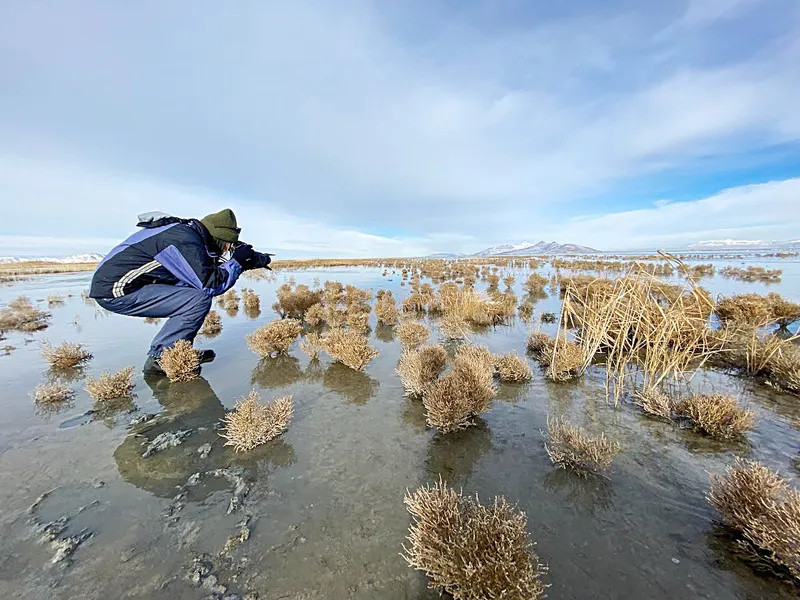
Retired Canyons School District teacher Linda Dalton Walker grew up swimming in the lake and has spent years documenting it through photography and painting. What began as a landscape painting trip in the 1980s became a lifelong mission after an encounter with a bird.
“A great blue heron took off in front of me, and I was just enamored,” she said. “That was the beginning of my journey with Great Salt Lake.”
Since retiring 11 years ago, Dalton Walker spends several days each week exploring and photographing the lake’s birdlife and changing shoreline. Her work has appeared in exhibitions highlighting the lake, including an upcoming solo photography exhibit, “Great Salt Lake: America's Inland Sea and Her Birds,” opening Sept. 4 at Red Butte Garden.
Dalton Walker said many Utahns know the lake is shrinking, but they have never experienced it firsthand.
“So many people don't go out to Great Salt Lake; they just see what's on the news,” she said. “If they go, they’d know the water used to come up to the causeway and now, it’s all dirt.”
Dalton Walker’s photographs focus on migratory birds that depend on the lake, including snowy plovers, eared grebes and phalaropes. With the declining water levels, she has watched habitat and feeding areas disappear.
“One time in 2019, I spent all day long photographing this one area. There were American white pelicans, great blue herons, bald eagles, kestrels, some dabbling ducks, all of them in one area. I have never experienced that since,” she said. “The birds don't have a voice. People need to understand how many animals need the Great Salt Lake to survive.”
Dalton Walker encourages residents to conserve water and support conservation efforts protecting the lake.
Corner Canyon High School 2026 graduate Eric Larson advocates for changes with residential yards. He suggests replacing traditional Kentucky bluegrass with buffalo grass, a drought-tolerant alternative that requires less irrigation and maintenance.
Larson said outdoor watering is a major use of municipal water, making residential landscapes important to water conservation.
“The biggest thing is most people don’t know that they can help with the Great Salt Lake; they think there’s nothing the individual person can do,” he said.
Larson estimates widespread adoption of water-efficient turf could save hundreds of thousands of acre-feet of water annually while lowering maintenance costs for homeowners over time. He added businesses, schools, churches and government buildings also could replace their Kentucky bluegrass with buffalo grass or xeriscaping.
“This won’t be a full solution, but it gets us very close and it will help us stall for more time,” he said.
Larson believes education is one of the most important tools for protecting the Great Salt Lake.
“I think studying the Great Salt Lake belongs in schools,” he said. “People would be a lot more interested to learn about something they cannot only affect, but also, effects them.”
Larson, an avid snowboarder who was concerned about the lake’s decline and its effects on Utah’s winters, first researched the impact as a concurrent environmental science project. Now he plans to share his findings with legislators.
Both Dalton Walker and Larson share the same message: individual actions matter.
Dalton Walker plans to return to the lake nearly every week, camera in hand.
“I can’t sit back and watch this happen without informing people,” Dalton Walker said.
Larson adds: “People can be a lot more involved, especially when they learn if they change what’s going on with their own home, it will impact the Great Salt Lake. That’s powerful.”
Linda Dalton Walker’s 40-photograph exhibit, “Great Salt Lake: America's Inland Sea and Her Birds,” will run Sept. 4-29 at Red Butte Garden, 300 Wakara Way, Salt Lake City. She will give a free presentation at 1 p.m., Sept. 12, with a reception following.