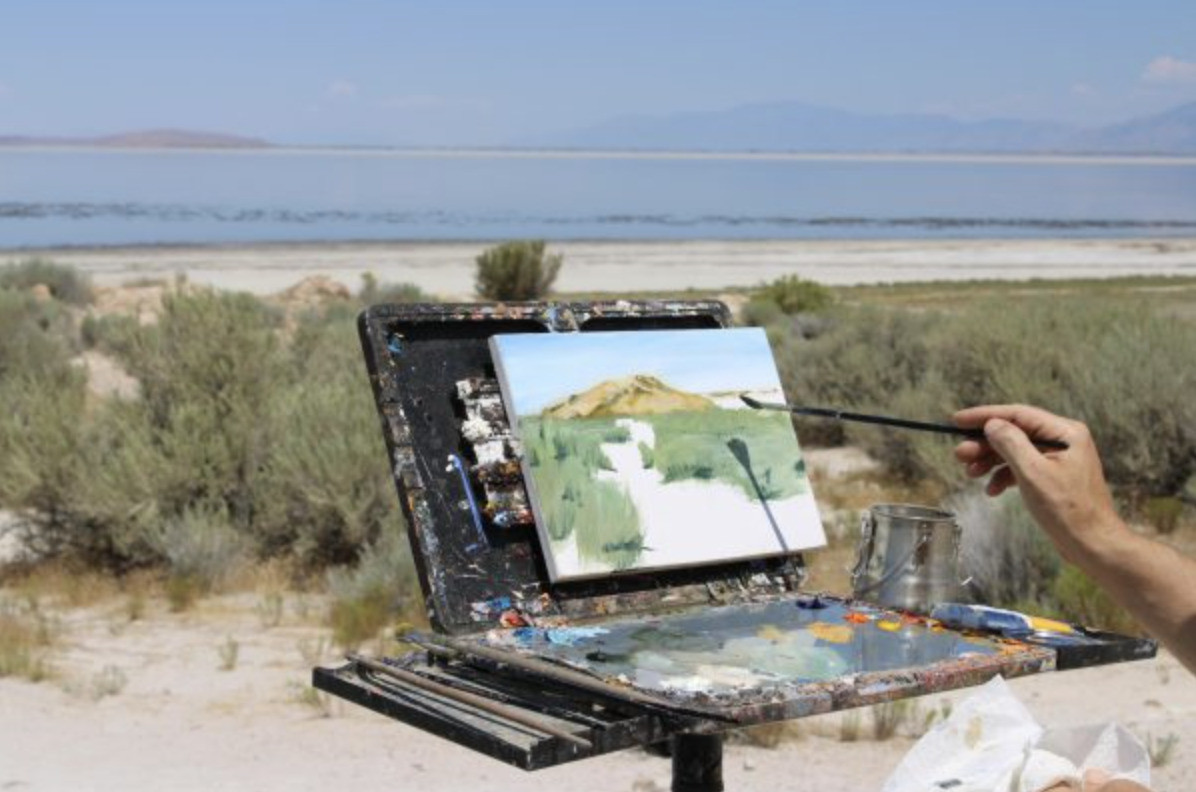
Local artist Erik Linton started “Threshold,” a painting project to document the lake’s declining condition and educate viewers on its natural ecosystem.
This article is published through the Great Salt Lake Collaborative with funding from Love the Lake, an initiative of the non-profit Great Salt Lake Alliance. Editorial decisions are made independently by the Collaborative and partner newsrooms. This story was written by Georgia Metcalf for the collaborative as part of a partnership between Amplify Utah and The Daily Utah Chronicle.
Erik Linton didn’t start out with a mission to paint the Great Salt Lake, but finds himself at the southeastern end of the lake on a sunny Monday afternoon.
The 42-year-old Cache Valley artist began painting landscapes over a decade ago, illustrating the red rocks of Southern Utah before inspiration struck for what he describes as his most ambitious project to date: painting the Great Salt Lake every day for a year.
By painting the lake in its current state — with 56% of the lakebed exposed and water levels sitting at 31.4% — Linton said he hopes his series of paintings will visually preserve it for future generations.
“Hopefully my paintings don’t outlive the lake, but it’s definitely a motivation for getting out there and wanting to paint it,” he said.
Inspiration
The initial idea emerged in February 2026 when Linton realized he could be part of “the last generation of artists who can personally go out to this landscape and capture the lake and the ecosystem.”
His drive to create the project came from that realization. “That just kind of motivated me to spend this next year painting it as much as I can,” he said.
Growing up in Davis County, Linton said he witnessed the lake rapidly shrink throughout his life.
“It didn’t seem like there was a whole lot of talk about it,” he said. “I want people to know this is a landscape that is already in decline. We’re at the tail end of a decline.”
The lake’s low levels have been the subject of intense media coverage. Dust storms carrying toxic heavy metals and broader ecosystem collapse are just two of the environmental issues resulting from the loss of overall water volume.
Linton, who got his Master’s degree in public health before becoming a painter, said visual art can play a vital role in our understanding of the lake. He said he hopes his project can combine the hard numbers of scientific data with imagery that “[helps] people connect in an emotional and visual way to the lake.”
In fact, he said, his paintings might tell a more accurate story one day. His grad school research is “all outdated now,” but he can imagine someone looking at a painting “100 or 200 years from now” and seeing clearly how the lake once was.
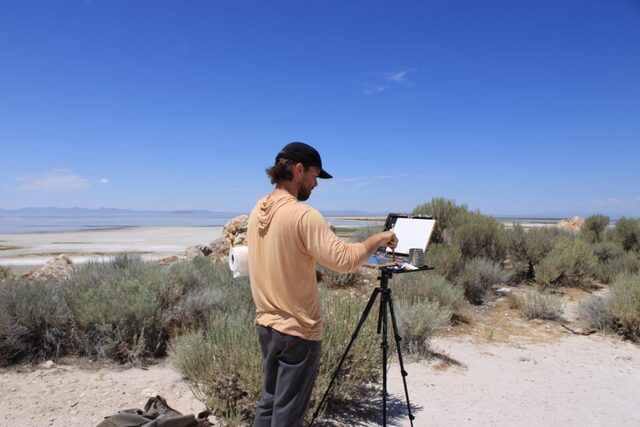
Linton does these onsite paintings to show the lake’s varying landscapes. (Georgia Metcalf)
Scenes from the lakebed
Linton dedicates one full day each week to “going out, hiking around, exploring [and] creating some art” in different spots around the lake, he said. But he paints it every day.
Recently, he has been painting the north arm of the Great Salt Lake, an area he describes as “pretty much dead.” His work at the site focuses on striking a balance between the site’s beauty and the alarming ecological consequences from the lake drying up.
“It’s kind of a weird balance where there’s still beauty even in this decline,” he said. “There’s cool colors because you get the really pink water and blue skies, but I walk out there and find bird carcasses everywhere.” Despite this decline, there are still small pockets of life in freshwater and saltwater springs scattered throughout the north shore — little “oases of life,” Linton said, where you can still “connect with wildlife and see so much beauty.”
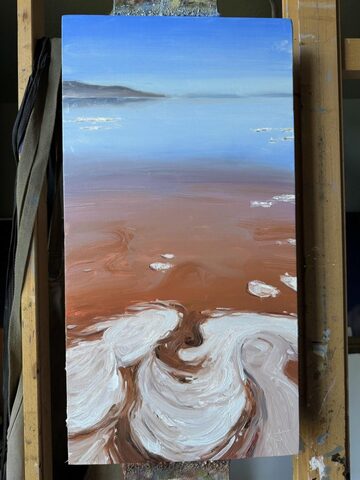
The north arm of the Great Salt Lake, as painted by Linton (Photo courtesy of Erik Linton).
The Great Salt Lake’s north arm made headlines recently as the site of the proposed Stratos hyperscale data center. It’s one of Linton’s biggest concerns for the lake’s well-being.
“Before the Stratos data center was even known by the public, I’d already started my project. I’d been walking through the Hansel Valley exploring the springs that are at 20% capacity,” he said. “All of a sudden, I find out about this data center, I’m like, ‘oh, these springs are going to be gone, they’re tapping into the same groundwater that these springs come from.’”
Despite ecological and man-made threats to the area, there is still “so much to save,” Linton said.
As part of his conservation efforts, Linton collaborated with organizations like Grow the Flow and the Great Salt Lake Audubon Society, offering his work in an effort to educate Utahns about what he says is one of the largest conservation issues in the American West.
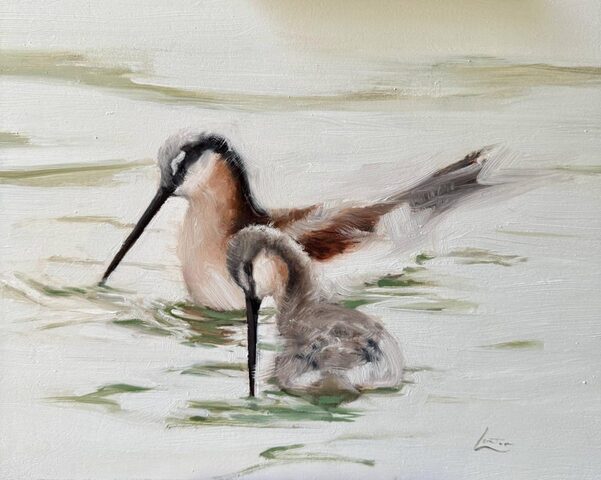
Linton’s work often depicts species native to the area. (Photo courtesy of Erik Linton)
He said this creates an “entry point” for education and awareness regarding the lake.
“I can effectively create the artwork, but I think if I’m able to collaborate with the right organizations, it really helps make it an educational thing,” he said.
Linton’s ultimate goal for his own work and collaboration with other conservation groups is an exhibition of the “at least 100” paintings, depicting everything from dust storms to animal species around the lake, he says he’ll have completed by the end of the project in March 2027. He hopes to showcase his work next fall.
“I feel this obligation as an artist,” he said. “I could just be painting beautiful barns or something like that, but I do feel like art has this powerful role to play in history.”
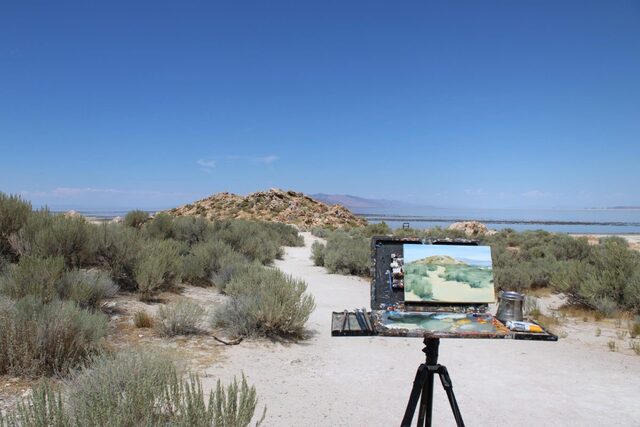
Linton’s finished first iteration of an upcoming work from July 20, 2026. (Georgia Metcalf)