
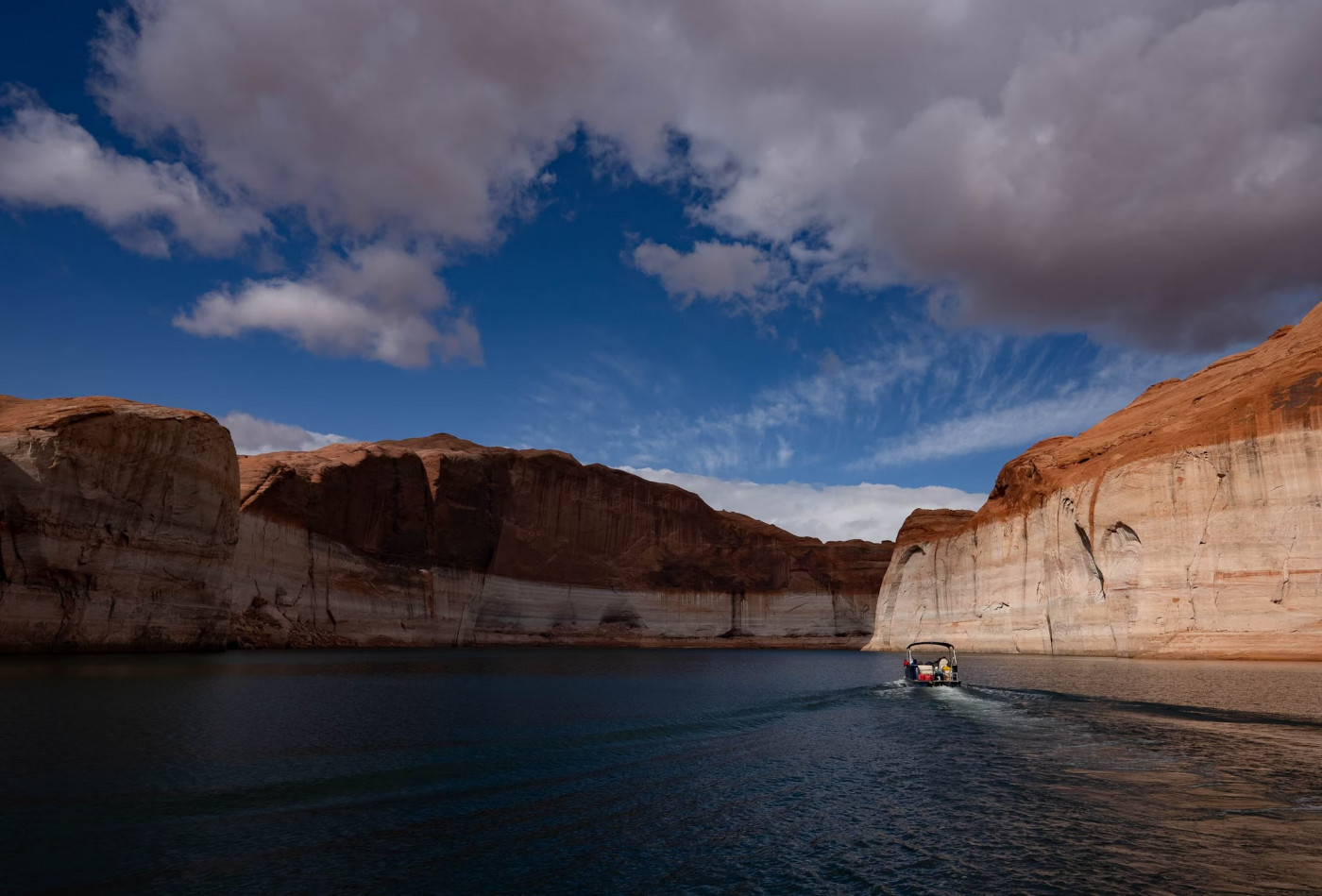
The federal government released its two-year operating plan for the Colorado River, including Lake Powell and Lake Mead.
The Trump administration won’t force Utah and other Upper Basin states to cut their Colorado River water use over the next two years, but Lower Basin states like California will collectively slash their consumption by over 1 million acre-feet per year.
The Bureau of Reclamation on Friday released its two-year operating plan that details how the agency will manage the Colorado River and the nation’s two largest reservoirs, Lake Powell and Lake Mead. It also released a record of decision to finalize a 10-year framework that includes ranges for future operating plans and flexibility if states eventually come to a long-sought consensus deal in the future.
“These decisions provide a water management strategy for Basin stakeholders to respond to the prolonged drought by incorporating flexible tools and voluntary actions while leaving room for consensus agreements,” said Andrea Travnicek, the Interior Department’s assistant secretary of water and science.
Lake Powell and Lead Mead both hit record lows this month. Water levels at Powell sat at 3,519 feet above sea level on Aug. 20 — just 9 feet above the level Reclamation says is critical for “continued operational reliability at Glen Canyon Dam.”
The combined contents of the two reservoirs has not been this low since Lake Powell began filling in 1963, according to Reclamation.
In the new plan, Reclamation upped its target elevation at Lake Powell from 3,500 feet to 3,510 feet.
Glen Canyon Dam’s power pool elevation is at 3,490 feet. Below that level, water can no longer flow through the dam’s penstocks and generate hydropower, and water must be released through tubes not designed for long-term releases.
Increasing the target elevation to 3,510, “gives a little bit more decision space to see what might be happening while we continue to be in this prolonged drought,” Travnicek told reporters Friday morning.
How Reclamation will operate Powell this year
Reclamation will begin the 2027 water year, which starts on Oct. 1, with low releases out of Lake Powell based on the latest 24-month hydrology forecast.
The agency plans to release between 6 and 7 million acre-feet from Lake Powell over the next year and will adjust releases in April to keep the reservoir above 3,510 feet.
Under Reclamation’s new plan, Lake Powell would stay above or right at 3,510 feet, according to the most probable forecast released by the agency.
During recent drought years, though, the agency’s “minimum probable forecast” has been closer to reality. That study shows Powell dropping below 3,510 by the end of January 2027 and dropping below minimum power pool by September 2027.
Releases out of Powell could drop as low as 5 million acre-feet in order to keep the reservoir at the target level, according to Reclamation.
What this means for Flaming Gorge
Reclamation and states are working on a “successor agreement” to an expiring drought response plan that determines releases from Upper Basin Colorado River reservoirs, such as Flaming Gorge, to boost Lake Powell.
“That process will be working very closely with the states and those that are impacted,” Travnicek said.
This year, up to an additional 1 million acre-feet of water is flowing out of Flaming Gorge to keep levels up at Powell.
The agency will try to prioritize recovery of Flaming Gorge, Travnicek added, but that may not happen right away due to the low elevations at lakes Powell and Mead.
“Recovery will only occur if we have a wet year,” Gene Shawcroft, Utah’s Colorado River commissioner, told The Tribune.
But recovery “should be the priority” before states and Reclamation talk about releasing additional water from Flaming Gorge and other upper reservoirs, he added.
What cuts will look like in the Lower Basin and Mexico
Reclamation adopted much of the Lower Basin’s proposal it released earlier this year, Travnicek said.
Here’s how much each state is expected to cut, based on the Lower Basin proposal:
Arizona: 760,000 acre-feet California: 440,000 acre-feet Nevada: 50,000 acre-feet The federal government has also been negotiating with Mexico, which has agreed to a 250,000 acre-feet cut for each of the next two years, Travnicek said.
That will lead to a total of 1.5 million acre-feet of water shortages in the Lower Basin in 2027 and 2028.
The guidelines also call for Lower Basin states to voluntarily conserve an additional 700,000 acre-feet from 2026-2028 and creates a new “Federally Managed Water Resources Pool” in Lake Mead to meet delivery obligations and offset some cuts to Lower Basin tribes.
“This is a bridge, not a permanent solution,” JB Hamby, California’s Colorado River commissioner, said in a statement Friday. “California, Arizona, and Nevada have shown that states can compromise, make difficult decisions, and reduce water use when the river demands it. But three states cannot carry the responsibility of all seven.”
Why aren’t Utah and other Upper Basin states to being forced to conserve?
Reclamation did not include any mandatory cuts for Utah or the other Upper Basin states — Colorado, New Mexico and Wyoming — in its two-year plan.
The federal government has “different responsibilities and authorities” in the Upper Basin and Lower Basin, Travnicek said.
The Interior Secretary is considered the “water master” in the Lower Basin. But in the Upper Basin, Reclamation’s authority only covers the reservoirs within the Colorado River Storage Project, which includes Flaming Gorge on the Utah-Wyoming border.
While Reclamation’s plan doesn’t include mandatory cuts, its 10-year framework allows Upper Basin states to voluntarily conserve up to 200,000 acre-feet per year.
Shawcroft told reporters in July that it would take Upper Basin states three to five years to conserve that much.
Upper Basin states have said they take “mandatory cuts” each year based on how much water is actually flowing in the river, streams and creeks upstream of Lake Powell.
Water users have faced cuts across Utah this year after a record hot and dry winter. Those that have received their water in Utah this year are senior rights holders that date back before the Colorado River Compact was signed a century ago, Shawcroft said.
“We just don’t have that much water to give,” he added. “Mother Nature hasn’t provided it this year and hasn’t over the last 20 years.”
Between 2020 and 2024, Upper Basin states used 3.8 million acre-feet per year on average and Lower Basin states consumed 6.5 million acre-feet per year on average, according to Reclamation.
What’s next
Reclamation’s 10-year framework allows states to continue negotiating in hopes that they agree on plans in future years.
“The reality is simple: there is less water in the Colorado River, and the reductions ahead may be greater than anything we have faced before,“ Hamby said. ”A durable agreement must spread that responsibility fairly across the basin, with all seven states and both countries doing their part.”
“The next two years give us an opportunity to reach that agreement,” he continued.
Travnicek said she can’t answer how the operating plan may affect the risk of a lawsuit going forward.
“Having negotiated water for a long time, it’s better to do that with the folks that are the water managers around the table versus having a judge do that,” she added.
Arizona has threatened to sue over mandatory cuts to its share of the river. Utah lawmakers have also shored up funds in preparation for a potential Colorado River lawsuit.
“I believe the the odds of us coming to a solution, a consensus agreement, are much, much higher with the [record of decision] and with the operation plan out,” Shawcroft said. “It was difficult to negotiate because we we had no boundaries. Now we do.”
“We will all consider ourselves better off if we come up with a solution,” he added, “than if we just continue to let the feds come up with that solution.”