
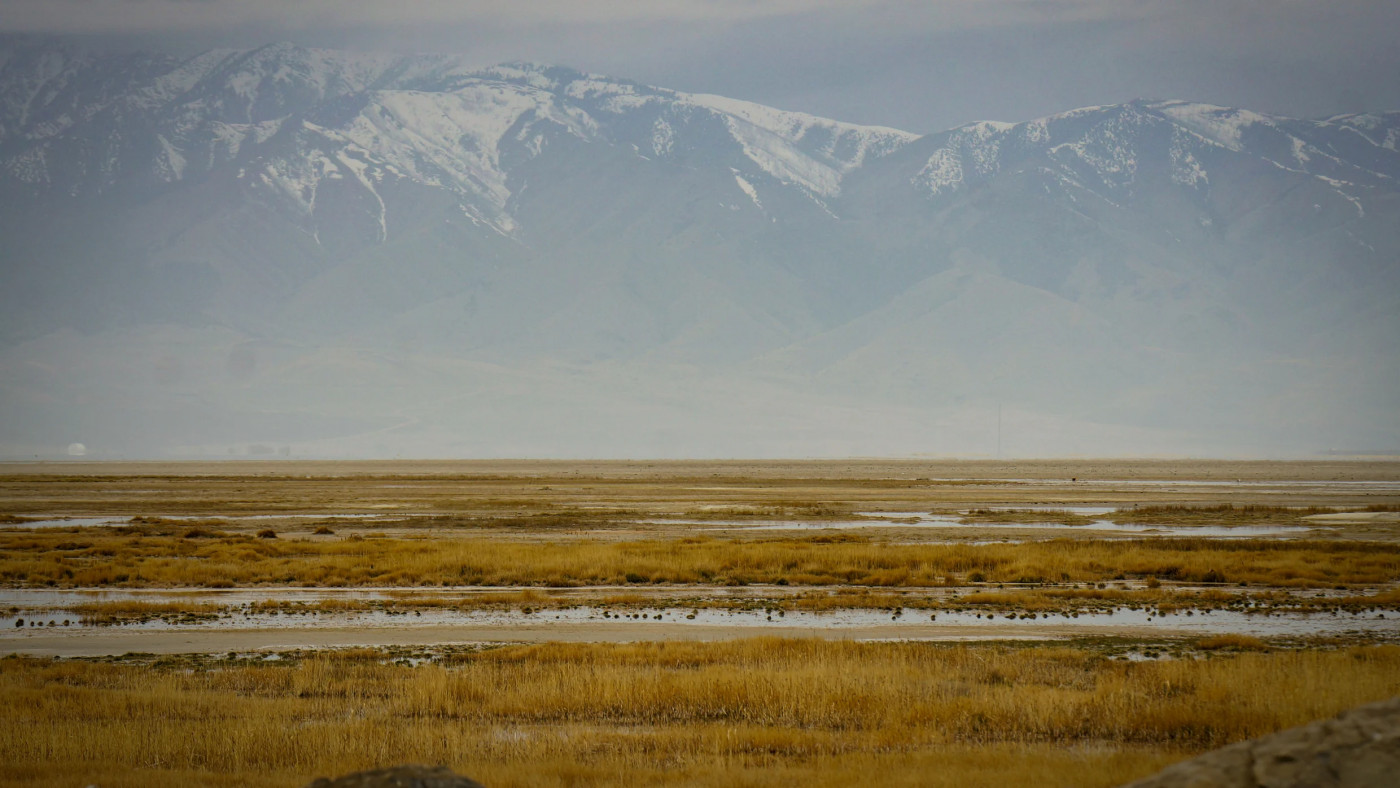
The Great Salt Lake is in trouble — again.
Just four years after dipping to a record low, the lake that's vital to Utah’s population, economy and ecosystems appears headed back toward the danger zone. Its water level is now just around one foot above where it bottomed out in 2022.
If you’re wondering what factors drive the lake’s plight, the answer is “all of the above,” said University of Utah hydrology professor Paul Brooks. The current moment is fueled by both a changing climate and changing water use.
While cities and farms may not be taking more water from the streams feeding the lake, he said, the way they use that water has changed over the years — preventing some of it from returning to the lake.
“We haven't been diverting any more water,” Brooks said, “but we've been consuming a larger fraction of what we divert.”
At the same time, climate change, which scientists agree is driven by fossil fuel emissions, has elevated Utah’s baseline temperatures. That extra warmth is increasingly powering the state’s droughts, messing with snowpack and supercharging evaporation.
“The thing about communicating what is driving low levels in the Great Salt Lake is you can't just attribute it to one factor,” said Siiri Bigalke, a researcher at Portland State University who has studied the lake’s decline.
If you zoom out, the lake’s water balance is a simple math equation. Precipitation and streamflow are the only ways water gets into the lake, primarily via the Jordan, Weber and Bear rivers. Evaporation is the only way water leaves the lake. Still, it can be hard to know how much each element contributes to the predicament.
“You could say, ‘I have a negative balance in my bank account,’” Bigalke said. But “‘is that because I'm spending more money, or is that because I'm taking in less money?’”
That’s why she began her research while studying at Utah State University. To find out how much each variable — streamflow, precipitation and evaporation — drives the lake’s decline, she first needed to compute how much water has gone into and out of the lake each year since 1950.
Then, she ran three scenarios, each time holding two variables constant — keeping them at their mid-1900s averages — and allowing the third to play out as it did in reality.
She concluded that low streamflow was responsible for around two-thirds of the lake’s freefall to its 2022 record low. Precipitation fluctuations had a negligible impact. Around one-third of the lake’s decline was due to rising evaporation because of warming temperatures.
Her study calculated that the lake’s 2022 record low would not have occurred without the increase in evaporation. So, focusing on streamflow isn’t wrong, she said, but it doesn’t tell the whole story. When it comes to solutions, it’s important to recognize that evaporation is becoming a bigger piece of the pie.
“If anything, it's actually maybe more of an argument to try to conserve water going into the lake,” Bigalke said. “If the linear rate of evaporation continues, there's going to be even more water coming out of the lake due to a process that people have no control over.”
Other factors driving decline are in Utah’s control. As homes and farms have tried to use water more efficiently, Brooks said that’s led to unintended consequences.
Essentially, it comes down to the difference between diverting water and consuming it. Water that goes down someone’s sink drain in Salt Lake City might get cleaned and sent to the lake. When water is sprayed on a lawn or parking strip, however, it’s consumed or evaporated. As indoor water use becomes more efficient — think new toilets and appliances — a growing percentage of urban water is now eaten by outdoor landscaping.
Agriculture remains the basin’s top water user. It accounts for 65% of the water depleted from the Great Salt Lake basin, according to the latest report from the state’s Great Salt Lake Strike Team. But Wasatch Front urbanization is shifting more of the responsibility to lawns.
“Agricultural water use has not increased. We're losing farms at a rapid pace, and that water is being converted to homes,” Utah Great Salt Lake Commissioner Hannah Freeze said. “So, it may be an easy spot to point, but I don't think that's what's driving this.”
State data shows city water use now accounts for a record-high 25% of the water depleted from the Great Salt Lake Basin. Freeze acknowledges that Utahns may be sick of hearing the word “conservation,” but said it remains the biggest way to help.
Still, Utah agriculture does have a big opportunity to step up. Freeze said conservation efforts are gaining ground. Recent changes in state law now allow farmers to lease their water so that it can stay in streams without losing their water rights. A new program on the Colorado River side of Utah is testing how state money can help make that happen.
Unintended consequences can also happen at farms, though.
Traditional flood irrigation may be considered inefficient because a lot of water runs off of the field, but that runoff isn’t a loss for the lake. It can soak into the ground or flow back to a stream. As farms update their irrigation tech, plants consume more of the water and less returns to the watershed.
These ripple effects stem from people trying to do the right things, Brooks said, but they can still hurt.
“All good things to do, but in aggregate, they may not get water to the lake,” he said. “And the longer we wait to get water to the lake — the longer we wait to deal with this — the more we need to fill up the subsurface before the lake actually starts to respond.”
That’s because of something he described as “hydrologic memory.” Consecutive dry years put Utah in a hole that takes more than one good year to dig out of.
“We have to stop thinking about each year as independent of the one before,” he said.
Historically, the state’s system for delivering and using water was based on a rural agricultural society. The people who created that system did a great job getting water to farms, but he said that approach doesn’t fit Utah’s current population or climate.
After decades of use-it-or-lose-it water law, it’ll likely take some time to turn that ship around.
State leaders have dedicated more than $300 million to saving the lake in the past four years. Freeze pointed out that many of the state’s lake-saving efforts — from updating irrigation systems and leasing water on farms to getting the mineral extraction industry to conserve — are still in their infancy.
“Everyone is collectively turning towards the lake, and we're all working together,” she said. “That gives me a lot of hope.”
To stabilize the lake, Freeze said, Utah would need to send it an additional 250,000 acre-feet of water each year. One acre-foot is enough water to cover an acre of ground a foot deep in water. A total of 450,000 acre-feet has been dedicated to the lake over the past three years, she said.
Even though it may look like lake-saving efforts are moving slowly, Brooks sees real progress, and he said expanding the state’s water leasing efforts would be a good step toward that goal.
But progress can be fragile. His biggest fear is that Utahns will turn to blaming each other rather than working toward a solution. Now that we can see how climate and water use patterns are changing, he said it’s up to Utahns to design a plan that will work for the Great Salt Lake’s future.
“If Utah can solve this here,” Brooks said, “it's a big deal not only for Utah, but it shows what can be done in these types of situations.”