
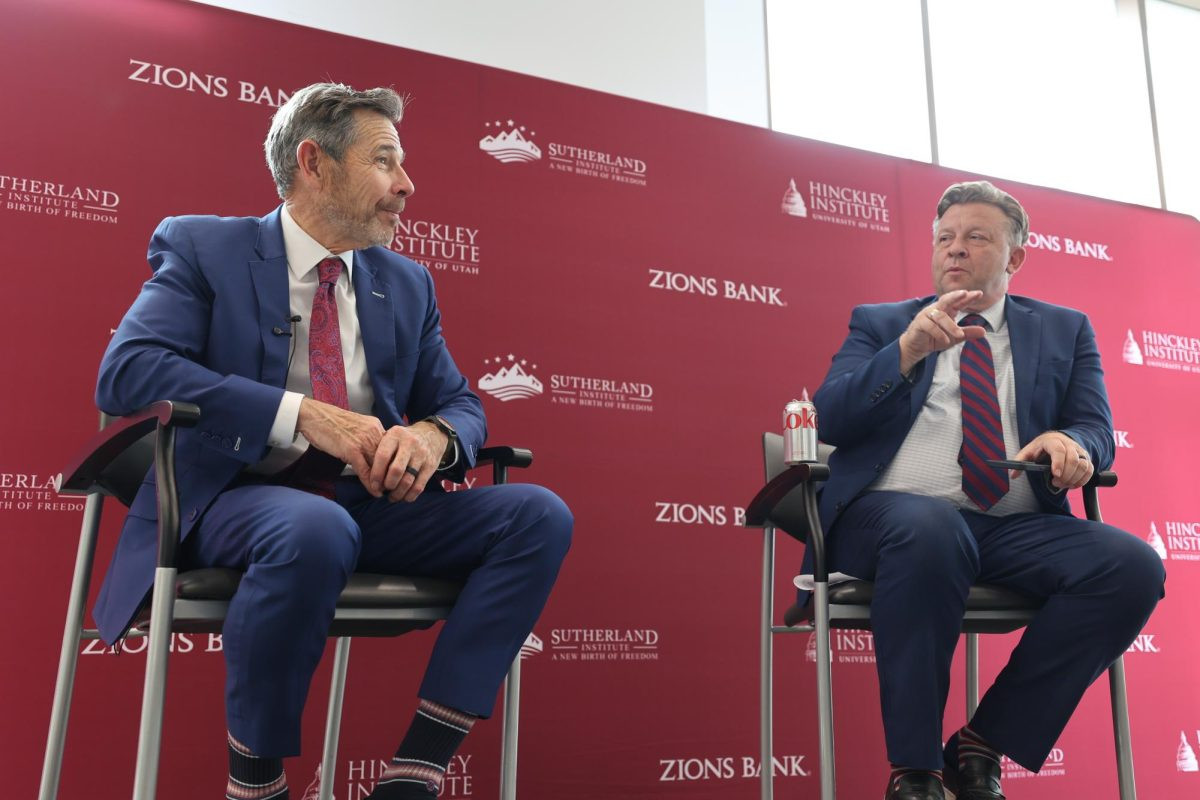
During the forum, Curtis said Utah may not receive President Trump’s billion dollar promise to aid the Great Salt Lake this year. In reality, he thinks it could take a couple.
This article is published through the Great Salt Lake Collaborative with funding from Love the Lake, an initiative of the non-profit Great Salt Lake Alliance. Editorial decisions are made independently by the Collaborative and partner newsrooms. This story was written by Will Ruzanski for the Collaborative as part of a partnership between Amplify Utah and The Daily Utah Chronicle.
In a water policy forum Monday, Sen. John Curtis, R-Utah, said he’s urging Congress to approve President Donald Trump’s $1 billion request to aid the ailing Great Salt Lake — but he wants something “bold” from Utahns in the meantime.
Speaking at an event hosted by the Hinckley Institute of Politics, Curtis said population growth and climate change have put “massive demands on water” in western states. So, he’s calling on Utahns to innovate.
“There is just not enough water,” Curtis told forum participants. “We know we need to do more conservation. We know we need to do more water rights … but I would add on to that another piece: we’ve got to be more bold and more audacious and think of the things that right now seem impossible.”
The discussion was co-hosted by the Sutherland Institute, a non-profit conservative think tank, as part of their 2026 Congressional Series. Monday’s discussion was moderated by Sutherland Institute president and CEO Todd Weiler, R-Woods Cross, a Utah State Senator who also works as a Salt Lake City attorney.
The “aha moment”
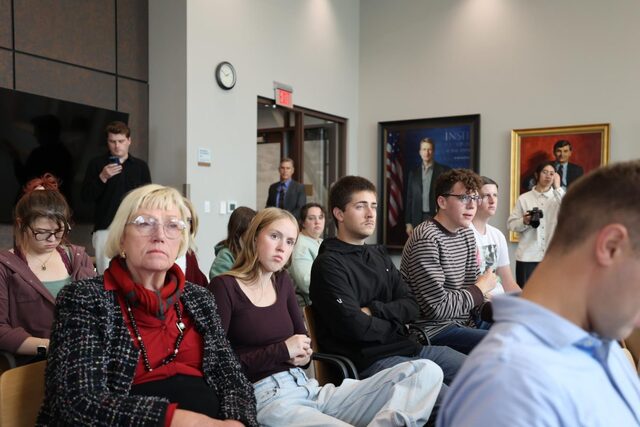
Students watch during a Hinckley Institute forum featuring U.S. Senator John Curtis, R-UT, on Oct. 19, 2026) (Will Ruzanski
Saving Great Salt Lake is key to a healthy region, Curtis said, both for the people and the economy. “No matter what you care about, you don’t want the Great Salt Lake suffering,” he said. “Many industries are based on the health of the Great Salt Lake, so if you care about the economy of the region, then you care about the Great Salt Lake.”
After learning more about the effects of a drying lakebed, including toxic, airborne dust, Curtis told forum participants he has started to better appreciate the lake’s ecosystem. “I don’t think any of us knew a few years ago that the dust was a problem. I don’t think any of us really thought through the larger ecosystem of the lake a few years ago,” he said. “That’s probably been my biggest ‘aha’ moment: realizing just how important this lake is to us.”
Policymakers, Curtis said, “can do a better job of talking about how broad this is. It’s not just an environmental issue; it’s a monetary issue, it’s a health issue, it really affects us in almost every aspect of our lives.”
Weiler described losing the lake as a broad, regional issue. “Our economy would be ruined,” he said. “It would be a disaster.”
Making the lake great again
Curtis said he doesn’t have all the answers. Instead, he’s looking to empower Utahns from the federal level as a U.S. senator. “There are a lot of people in Utah much smarter than me on the Great Salt Lake, so I view my job as saying, ‘okay team, what do you need?’” he said.
Curtis emphasized he’s working to educate Congress about Great Salt Lake and get federal money flowing to Utah. “That’s the mode that I’m in right now, working with my colleagues to help them understand why a billion-dollar investment in the lake is a good investment,” he said.
In April, Trump formally requested $1 billion from Congress to help save Great Salt Lake. That assistance is tied up in the president’s 2027 federal budget proposal and must pass a divided Congress before Utah sees any money, but Curtis said he’s uncertain whether Utah will receive the president’s full financial promise this year.
“In a perfect world, we get a billion dollars in this year’s budget,” he added. “In reality, we may work for a couple of years. I do actually think ultimately the federal government’s investment may far exceed a billion dollars, and probably should.”
Anti-mandates
Both Weiler and Curtis said they oppose mandating specific rules to save the lake, like agricultural regulations or lawn-watering rules. Instead, they want to bring water users in as stakeholders and educate them on the issue facing Great Salt Lake.
“If we don’t involve rural Utah, if we don’t involve agriculture… it’s a big mistake,” Curtis said. “Bringing them in as stakeholders and as partners, and not forcing them, but coming up with ways that don’t threaten their livelihood and their income, I think can be a very productive part of the solution.”
Curtis said working with large water users is one piece of “a very large puzzle.” He also advocated for increased infrastructure investment.
But Weiler said Utah’s State Legislature often experiences pushback for doing too little to save the lake. “I get a lot of calls and emails from concerned citizens, which I’m glad people are thinking about this problem, and they often accuse me and the legislature of not doing enough — and that may be a fair argument,” he said. “One of the things I often say to them is, ‘Look, the lake didn’t get this low overnight, and we’re not going to be able to fill it overnight.’”
Looking forward
The forum’s crowd was mostly college-aged students, which Curtis acknowledged. “We should listen to young people more,” he said. “Through most of our history, we’d have been better off to do a little bit more listening.”
Curtis said no saline lake in decline has ever been saved, and that’s why believes saving Great Salt Lake as so important. “Doing it here, figuring it out, is actually important for the world, not just Utah,” he said. “It’s important for the region, and that’s why I think it’s important to make a case federally for some assistance.”