
Utah and other Colorado River states confront record low water supply as negotiations over the river remain at a standstill.
Utah’s top official overseeing the Colorado River gave a serious warning alongside his counterparts from other states Tuesday: Utah’s farmers and ranchers, as well as some rural towns, are grappling with drastic water shortages from the ongoing drought.
“I want you all to recognize the significance and severity of the things we’re dealing with — totally unprecedented,” said Gene Shawcroft, Utah’s Colorado River commissioner, during Tuesday’s meeting of the Upper Colorado River Commission. “The real question is, what happens if next year looks like this? And I hope we don’t have to answer that question.”
Utah’s state engineer has already cut back “some of the most senior rights in Utah on the Colorado River system,” Shawcroft said. Those include water rights that date back to 1886 on Ashley Creek and 1906 on the Duchesne River, both tributaries to the Green River in eastern Utah.
Shawcroft cited other problems Utah has faced this year:
• A small mountain reservoir, one the state typically doesn’t release water from until early July, will be empty by June 29 — Monday.
• Streams that typically run at 1,200 cubic feet per second during spring run off peaked at 257 cubic feet per second this year.
• No water deliveries were made this irrigation season on the Price River system.
• The town of Emery will be out of water this week and hauling water.
• The town of Apple Valley, in Washington County, saw a main well go dry, and will be under emergency circumstances as it runs out of drinking water.

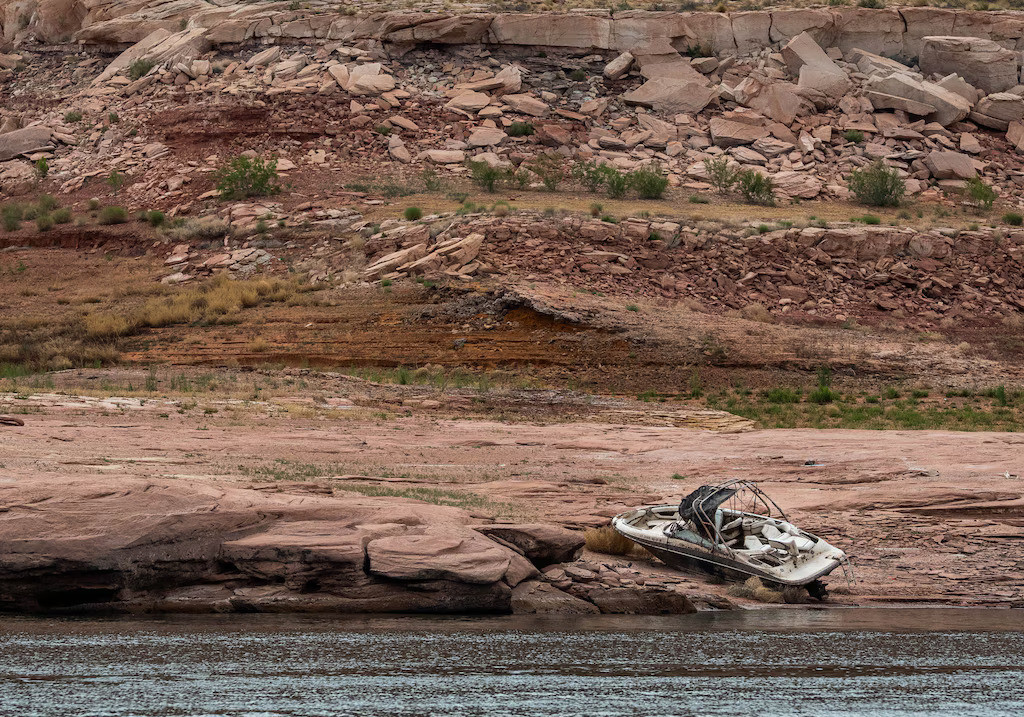
(Francisco Kjolseth | The Salt Lake Tribune) A fisherman tries his luck in the receding waters near Bullfrog Marina at Lake Powell on Friday, Saturday, April 24, 2026. The marina had to move to deeper water in the main channel of the reservoir across from Halls Crossing in May due to low water levels.
While streams and wells run low or dry across the state, Lake Powell and other major Colorado River reservoirs are also dropping towards record low levels. Meanwhile, states still can’t agree on how to share the river during dry years after current interim guidelines expire this year.
The Bureau of Reclamation’s latest forecast for the major Colorado River reservoirs was the “elephant in the room” during Tuesday’s commission meeting, said Becky Mitchell, Colorado’s commissioner.
“That shows the very dire, dire outcomes for Lake Powell and the upstream initial units, including Flaming Gorge, Blue Mesa and Navajo,” she added.
Reclamation’s “most probable” forecast shows Powell dropping two feet below minimum power pool by the end of March 2027. At that level, Reclamation can no longer generate hydropower at Glen Canyon Dam, and must use bypass tubes that were not intended for long-term water releases.
Status of negotiations
As the hydrology gets worse, it is more difficult for states to reach a solution for how to manage the waterway, Mitchell said.
The stakes are high: The Colorado River and its tributaries support 40 million people across the U.S. Southwest and northern Mexico, including multi-billion dollar agricultural economies, major cities from Salt Lake City to Phoenix and 30 federally recognized tribes.
As negotiations drag on and the federal government prepares to release its own plan next month, New Mexico’s Gov. Michelle Lujan Grisham has replaced her state’s lead negotiator, Estevan López, with Tanya Trujillo, the state’s deputy water engineer and a former U.S. Department of Interior official.
“We’re in a crisis,” Trujillo said, “and I have been appointed by our governor based on her interest and involvement in Colorado River issues and her discouragement at the fact that we have not been able to make more progress.”
“We can’t put the blame on one person’s actions or inactions,” she added, “but the situation in the basin is not OK.”
The federal government must have a new operating plan in place for the region’s reservoirs by Oct. 1, the start of the new water year. The Bureau of Reclamation plans to release a final environmental impact statement that will outline its preferred management alternative in July. It will release a final decision in August, said Wayne Pullan, Reclamation’s regional director for the Upper Colorado River Basin.

(Francisco Kjolseth | The Salt Lake Tribune) Hite Marina, long closed down due to the declining water levels of Lake Powell, is pictured from the Colorado River overlook on Saturday, April 25, 2026.
Those documents will be “largely procedural,” he added. The agency will lay out operating plans for the river system for 2027 and 2028, with hopes that the states will agree on those plans. Reclamation, in coordination with the states, will then develop new operating plans every two years through 2037.
One sticking point between the Upper Basin states and Lower Basin states is how to treat the reservoirs upstream of Powell, including Flaming Gorge.
The bureau is planning to release up to 1 million acre-feet of water from Flaming Gorge through spring of 2027 to prop up Lake Powell.
The basin should consider such releases a one-year stopgap, not a regular event, Shawcroft said.
“We certainly have sufficient reservoirs that are empty,” he added. “We don’t need additional empty reservoirs.”
This article is published through the Colorado River Collaborative, a solutions journalism initiative supported by the Janet Quinney Lawson Institute for Land, Water, and Air at Utah State University.