
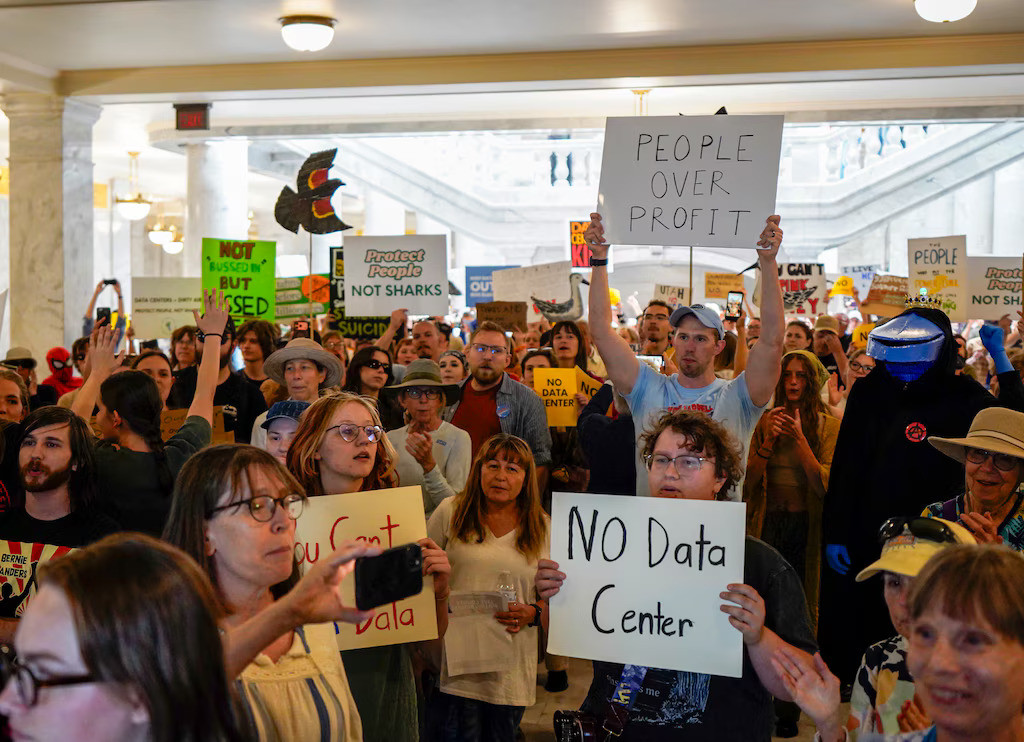
Board members decry “misinformation” about agency that approved the Stratos Project, which Senate President Stuart Adams defended as vital to national security after losing primary.
Note to readers • This story is made possible through a partnership between The Salt Lake Tribune and Grist, a nonprofit environmental media organization.
Two months after approving a controversial data center project in Box Elder County, the Military Installation Development Authority has hired a new boss.
The authority, called MIDA for short, approved the data center backed by celebrity investor Kevin O’Leary in April, sparking widespread backlash. The quasi-government agency acts as the local government authority in project areas it greenlights, and collects property taxes to fund infrastructure and economic development.
Businessman Dan Hemmert, who previously served in the Utah Senate and as director of the Governor’s Office of Economic Opportunity, will now helm the controversial agency. The MIDA board unanimously voted to hire him Friday morning.
“Dan will bring a lot to the table,” said Sen. Jerry Stevenson, R-Layton, a MIDA board member.
Stevenson also noted “a lot of misinformation out there” about MIDA, but did not elaborate. The senator’s plant nursery business was the subject of boycotts following MIDA’s approval of the data center.
The board declined to take any comments about the Stratos Project during Friday’s meeting.
“I’m glad to take this on,” Hemmert said in an emailed statement about his new executive director role. “MIDA does work that actually shows up in people’s lives in such an impactful way, and my job is to make sure we do it well and do it in the open.”
MIDA’s outgoing executive director, Paul Morris, was one of the main proponents of the Stratos complex as Box Elder County Commissioners weighed their own vote on whether to allow the development.
Morris began planning to step down from his position around a year ago, MIDA staff said. He was appointed as executive director in 2008.
The Stratos Project quickly became controversial as Utahns across the state expressed worry about its water, land use and energy demands.
The public particularly took issue with the project’s proximity to the Great Salt Lake. The site, which has not broken ground, lies in Hansel Valley, near the lake’s northernmost tip.
Plans have shifted over time, partly in reaction to the outcry. Initially, project backers said the site could cover 40,000 acres and require 9 gigawatts of energy — more than double the current use across the entire state of Utah — once fully built out. O’Leary later agreed to scale the project down to roughly 20,000 acres. No formal development plans have been filed.
Morris had said the Stratos complex would rely “100%” on natural gas drawn from the Ruby Pipeline spanning the valley. But both O’Leary and Utah Gov. Spencer Cox downplayed those assertions, noting the project could use a combination of natural gas, renewables and nuclear.
Cox also backtracked his own comments supporting Stratos, and told reporters last month he “worried” about MIDA and its processes.
The backlash from the project appears to have taken a political toll, as well. Two Box Elder County commissioners who were up for reelection lost their primary elections this week, following their vote to approve of the Stratos Project.
“Do I think that the data center vote cost me the election? Yes I do,” Commissioner Lee Perry said Wednesday.
Senate President J. Stuart Adams, who chairs the MIDA board and is considered one of the state’s most powerful politicians, also lost his primary election. The Layton Republican had spent nearly two decades serving in the Legislature, and has served on the MIDA board since 2008.
Critics decried MIDA’s approval of Stratos as secretive and rushed and questioned whether Adams had conflicts of interest related to the project. Adams has received significant campaign donations from companies doing business with MIDA in other project areas. Political observers told The Tribune that Stratos was likely factor in Adams’ defeat.
Adams has said that data center construction and the rush to control artificial intelligence is a modern “arms race.”
“The world’s not a safe spot,” Adams said during Friday’s board meeting. “Hopefully we keep in mind [MIDA] isn’t just economic development. It ... strikes at the very core of our freedom and making sure we protect what we have here in America.”
Utah lawmakers created MIDA in 2007 to support military efforts and prevent the federal government from closing Hill Air Force Base. But its mission has expanded significantly in recent years. Current projects include research parks, hotels, Deer Valley Ski Resort’s East Village expansion, and a new lodge and inn at Sundance Resort.