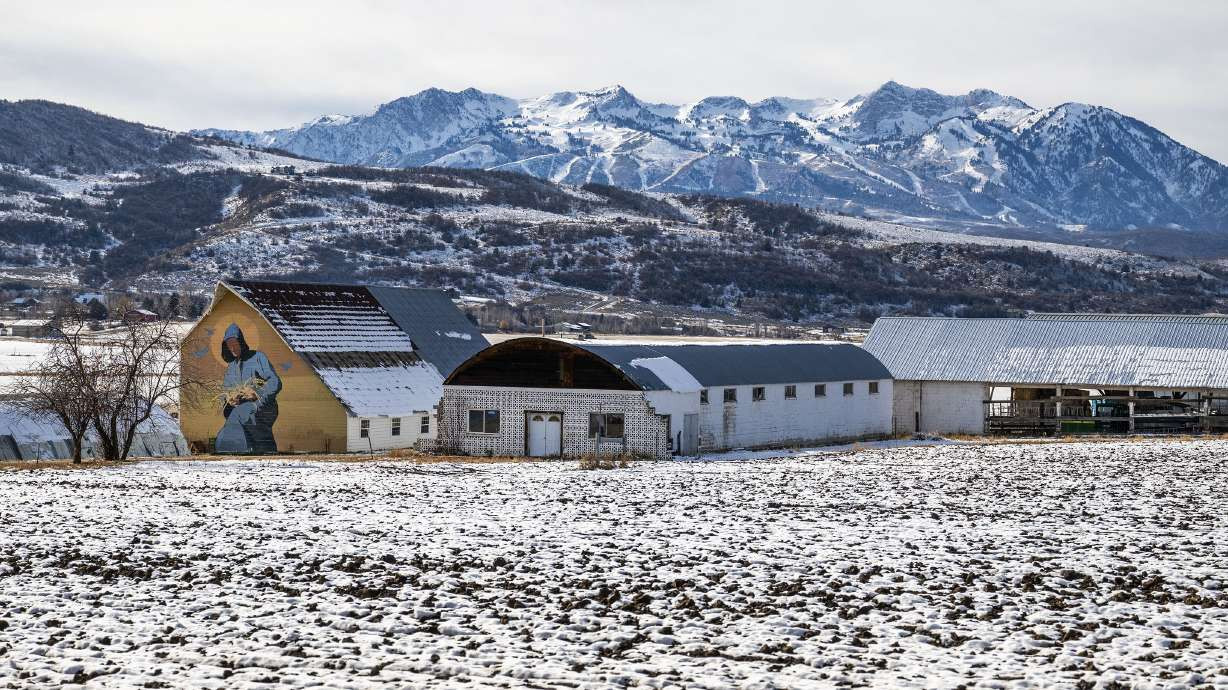
HUNTSVILLE, Weber County — Bill White remembers hearing about the Great Salt Lake being in peril as he was on the cusp of receiving a conservation easement for 1,050 acres of his farmland in 2022.
"By the time (the easement) was finished, the Great Salt Lake was in the news almost every day because of the declining water levels," said White, owner of the Historic Monastery Farm.
The lake would ultimately fall to 4,188.5 feet elevation, its lowest point on record. It inspired the Summit Land Conservancy, which completed the easement, to include a clause that allows some of the farm's water rights to be used for conservation, including instream flows for the Great Salt Lake.
That clause is now being utilized three years later. The Weber County farm announced plans to send 635 acre-feet of water to the Great Salt Lake annually through a 10-year water leasing pilot program with a state trust that oversees measures to get water into the lake, which finds itself struggling again.
Financial terms of the agreement were not disclosed on Tuesday, but the National Audubon Society and The Nature Conservancy, which co-manage the Great Salt Lake Watershed Enhancement Trust, and the Summit Land Conservancy assisted in securing the deal.
It may be the first of many similar deals in the future.
"This is an innovative project that preserves farmland and delivers water to benefit Great Salt Lake," said Marcelle Shoop, executive director of the Great Salt Lake Watershed Enhancement Trust. "The foresight of Bill White and the Summit Land Conservancy, and their willingness to pilot new ideas in partnership with the trust (and state land managers), illustrates the importance of broad collaboration to meet the challenges facing the lake and communities."
The deal, pending approval from state water regulators, comes as the lake remains almost 7 feet below its minimum healthy level.
The amount of water that will go to the lake translates to almost 207 million gallons of water annually, which is approximately a quarter of the farm's normal water usage. White said it won't drastically change production because the farm will focus on native plants and techniques that improve water efficiency.
It follows slight — but impactful — changes to the state's water law, which he said had previously made it difficult for farmers to donate or lease water without losing water rights.
The agreement can be extended 10 years, but he hopes that it can become a "template" for thousands of other farmers within the Great Salt Lake basin to follow if it's successful. It addresses one of the reasons for the lake's decline, which is the diversion of its tributaries during the irrigation season.
But the agreement is also why the Summit Land Conservancy granted the easement to preserve the farmland, said Cheryl Fox, the group's CEO. The easement helped preserve the lake's watershed from development.
White's goal is to be part of a program that becomes a "super flexible" template for farmers, so they can flex in and out depending on water needs any given year. Thus, Utah can balance its food security and lake health needs at the same time.
"This type of partnership is one of those mutually beneficial ideas that just makes sense," he said. "We're not losing any farming or production. Instead, we're utilizing the land more efficiently by switching our less productive fields to dry farming techniques, which enables us to keep the land in production and send that saved water to help Great Salt Lake."