
Editor's note: This article is published through the Great Salt Lake Collaborative with funding from Love the Lake, an initiative of the nonprofit Great Salt Lake Alliance. Editorial decisions are made independently by the collaborative and partner newsrooms.
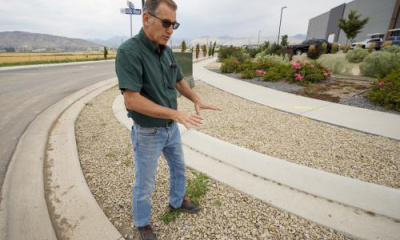
For South Weber residents Bob and Lori Anderson, conserving water meant changing the way their yard looked. In 2023, after learning about the “Flip Your Strip” rebate program, the couple removed the grass from their park strip and replaced it with trees, river rock and drought-tolerant plants.
“We spent about twice the amount of the rebate,” Bob Anderson said, estimating the project cost about $750. “We probably would have done it anyway. It uses less water and looks better than grass ever did.” The Andersons estimate their new landscaping uses about half the water their grass needed.
Their experience is part of a growing shift in northern Utah as drought conditions continue. Homeowners are watering less, replacing traditional lawns, repairing leaks and paying closer attention to how much water they use.
At the Weber Basin Water Conservancy District (WBWCD), the change is showing up in water-use numbers and the number of residents seeking help to replace their lawns. Darren Hess, WBWCD assistant general manager and chief operating officer, said overall homeowner outdoor water use is down about 10% compared with the same time last year. “We know conservation is happening,” Hess said.
The 10% decline in homeowner outdoor use comes at the same time as Weber Basin reduced wholesale irrigation deliveries by 20% this year. This 20% correlates with a savings of 47,000-acre feet of water, Hess said.
Weber Basin uses its drought contingency plan to decide how much water use should be reduced. The district estimates reservoir storage levels and then uses the plan to figure out the reduction. “We estimate what our June 1 storage will be in all of our reservoirs and then we go to our drought contingency plan. There is a chart in the plan that tells us how much we should cut contracts.”
This year, Weber Basin is in the plan’s moderate drought category. Based on that classification, the district reduced wholesale irrigation deliveries by 20%, delayed the start of the 2026 secondary irrigation season until mid-May and plans to end the season earlier than usual.
Secondary water is untreated water used for outdoor irrigation and landscaping. Weber Basin provides water to more than 700,000 residents across Davis, Weber, Morgan, Summit and Box Elder counties and supplies roughly half of the total drinking water demand in Davis and Weber counties.
“The water is saved in the reservoirs for next year,” Hess said. “We hope to save enough water in the reservoirs to at least have drinking water supply saved for next year.”
The district is also seeing more residents remove grass altogether. Weber Basin did not set a specific rebate goal this year, but by mid-summer, the district had received 946 rebate applications, roughly twice the number received at the same point last year, Hess said. The programs help homeowners replace traditional lawns with lower-water landscapes, improved irrigation systems and reduced outdoor water use.
“The district has opened the rebate programs to all communities regardless of water-wise, drought-tolerant or landscaping requirements they have adopted,” said Jon Parry, who oversees conservation programs at WBWCD. Communities that have adopted qualifying landscape standards can receive rebates of up to $2.50 per square foot, while others are eligible for up to $1.25. Hess said the district has budgeted $3 million this year for water conservation projects and has continued to ramp up that number over the past few years. Year-to-date, they have spent $1.8 million of that funding for various conservation programs.
For South Weber resident Tammy Custer, reducing water use meant eliminating most of her lawn without using a rebate. Custer and her husband spent more than three years removing grass from their 0.44-acre property because they felt they were using too much water. “We didn’t want to take the time and bother with conservation programs and rebates,” Custer said.
The property was once almost entirely grass. Now, it consists primarily of trees, rocks and a few plants that require watering. Custer said her husband did much of the work himself, making repeated trips with a wheelbarrow to move rocks. The result is a yard that uses far less water and one that Custer said is beautiful enough to host her son’s upcoming wedding reception.
South Weber resident Michelle DeLong Rasmussen took a different approach. When she and her family built their home more than a year ago, she spent months researching types of drought-tolerant, high-traffic lawns before choosing Tahoma 31, a drought-tolerant variety of sod.
Rasmussen said she was surprised by how little guidance is available to homeowners building new homes. “Because it was a new build, nobody on the city, county or state level cares what you do,” she said. “But if you already have a lawn and have been wasting water for years, there are rebates available to take out existing grass and put in exactly what I started with.”
Rasmussen said she is happy with her lawn, despite its higher upfront cost, but believes water-wise landscaping should be encouraged before new homes are built. “Our state should be doing everything they can to promote water-wise lawns and landscaping to new homeowners and developers so that the problem is corrected from the start,” she said.
Not everyone believes homeowners should carry the responsibility for conservation alone. One resident who did not want to be quoted told the newspaper that until state and local governments address new development and require water-wise landscaping, she does not plan to change her approach. “My lawn will continue to be green,” she said.
Hess said technology and personal responsibility will also play a role in Utah’s water future. The expansion of secondary water meters allows homeowners to track their consumption, identify leaks and monitor individual water allocations. “I think the best thing for conservation is to tell people how much water they should be using and then measure their water use,” Hess said.
Hess said some areas are using substantially less water than they did last year, while others continue to use their full allocations. “There are many areas that are down 50% or even 70% this year,” Hess said. “We also have those being shut off because they have used their 80% contract.”
Officials encourage homeowners to repair leaks, adjust irrigation schedules and apply only as much water as plants need. Most Utah lawns require about 1 to 1½ inches of water each week during the hottest part of summer.
Beginning in 2030, Utah law will require irrigation companies to bill customers based on actual water use rather than flat rates.
Travis Padilla, executive director of Grow the Flow Utah, said pricing could encourage further conservation. “Water in a desert is not endless,” Padilla said. “When prices reflect the true value of water, conservation follows.”
Cindi Mansell has been covering City Government for Davis Journal since 2021. She sits on the South Weber Water Improvement District Board.