
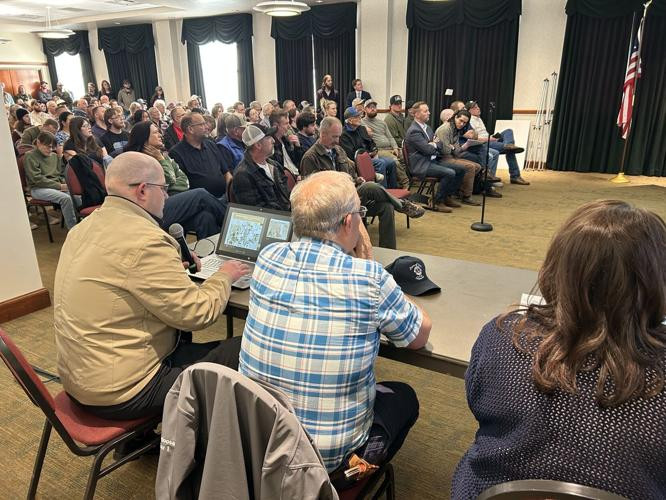
More than 350 residents packed Festival Hall Thursday night to weigh in on a proposed artificial intelligence data center that could become one of the largest industrial projects ever considered in Iron County.
The project, known as the Antelope Data Center, is proposed for roughly 640 acres about 15 miles northwest of Cedar City along Antelope Springs Road in unincorporated Iron County.
The Iron County Planning Commission listened to more than three hours of public comment as residents stepped forward one by one to speak. Concerns ranged from water use and air emissions to power demand, wildlife habitat and the long-term impacts of large-scale industrial development in the region.
While opinions were strong and passionate, speakers largely remained respectful throughout the evening, many thanking commissioners for their time and acknowledging the difficulty of the decision before them.
Several residents questioned the scale of energy needed to power the proposed facility, which includes plans for on-site natural gas-fired power generation to supply the data center’s operations.
Large data centers often maintain connections to the regional power grid even when generating electricity on site. It remains unclear, however, whether this facility would rely entirely on its own power generation or also draw from the grid.
“The amount of power that's being used. It says here on the sheet, 1.5 gigawatts. That's about equivalent to 1.2 million homes worth of power,” Nate Wilson said. “This is an absurd number to try and take into consideration.”
Wilson also pointed to research examining emissions from natural gas power generation, noting the potential health impacts associated with increased air pollution.
Cedar City resident Christy Demello also questioned who would ultimately ensure the project complies with safety and environmental standards.“I want to know who this place will answer to, who is going to make sure that they're safe, who is going to make sure that they're not over using their water,” she said. “I don't trust any company to regulate itself.”
Nearby landowners also raised concerns about how the project could affect their daily lives and local water supplies.
According to project materials submitted with the application, the facility would rely on a closed-loop cooling system designed to circulate and reuse water rather than continuously discharge and replace it.
The proposal estimates an initial one-time fill of about eight acre-feet, roughly 2.6 million gallons, to supply the cooling system used by the data center and associated power generation equipment.
Separate from the cooling system, project documents indicate about 3.13 acre-feet of water annually for indoor and outdoor uses such as employee facilities and limited landscaping at full build-out of the campus.
That operational estimate is the number often cited when comparing the project’s long-term water use to a handful of residential homes.
However, the proposal notes the eight acre-feet required to initially fill the cooling system is not included in that annual operational total.The documents also acknowledge that if water loss occurs over time, including evaporation, maintenance or system flushing, additional water could be required periodically to refill the system.
Construction of the facility would also require additional temporary water use, estimated in the proposal at roughly 10 to 20 acre-feet per year during the construction phase.
Iron County Water Conservancy District General Manager Paul Monroe previously told St. George News the facility could be required to install a metered connection that would allow officials to verify that water use remains within the limits outlined in the proposal.
The economic impact analysis included with the proposal does not include a hydrological assessment or detailed consumptive water use study. It notes that water availability and long-term groundwater impacts fall outside the scope of the report.
The location of the proposed development also places it within the Beryl-Enterprise groundwater basin in Escalante Valley, an area already governed by a state groundwater management plan.
The Utah Division of Water Rights adopted the Beryl-Enterprise Groundwater Management Plan in 2012 after studies showed groundwater in the basin was being withdrawn significantly faster than it could naturally regenerate.As a result, the basin has been closed to new groundwater appropriations. This means new developments generally cannot obtain new groundwater rights and must instead purchase and transfer existing rights from other users.
Project documents acknowledge the property currently has no active water source.
If the project proceeds, developers say the facility could either connect to the Iron County Water Conservancy District system or establish a new public water system supplied by wells. In either case, the project would require acquiring existing transferable water rights within the basin.
Demello questioned how water use would be prioritized if shortages occur.
“As water restrictions become necessary, and I think we all have to acknowledge that's going to happen, my question would be, where do they rank on the priority list?” Demello said. “Are they above residents? Are they above hospitals?”
Iron County Planning Commission members prepare for meeting inside the Heritage Center, Cedar City, Utah, March 5, 2026. Photo by Jeff Richards, St. George News / Cedar City News
Joe News, who said he lives about five miles from the proposed site along Antelope Springs Road, described how limited water availability already shapes life on his small farm. News said his property operates on about 2.25 water shares, enough to support his family and roughly 50 goats.
“If I'm using one-third the amount of water that they're planning to use there, I'm very skeptical that that's actually going to work,” News said. “I can actually feed 50 goats and a family out there, and it takes about a third of the water this power plant is going to use.”
News said the project could also dramatically increase traffic near his property.“There are lives of people that will be affected, real people that live right there on the doorstep,” he said.
Others questioned the economic projections tied to the development.Jesse Harris, a technology professional with about 30 years of experience, including 15 years in cybersecurity, urged commissioners to closely examine the project’s claims.
“One of the skills you pick up in cybersecurity is learning how things pass the sniff test,” Harris said. “You look at stuff and go, ‘This doesn't seem right.’”
Harris said data centers historically require relatively small workforces because many operations are automated.
“The history of data centers is that they're largely automated. They don't need very many staff,” he said. “Humans are expensive, and technology companies focus on reducing that expense as much as possible.”
Facilities of this size often generate hundreds or even thousands of temporary construction jobs during the building phase, but long-term operations typically rely on far smaller staffs.
Industry studies and public reporting on facilities operated by companies such as Meta, Google and Microsoft show permanent employment at many large campuses ranging from several dozen to a few hundred workers, depending on the size and number of buildings.
At full build-out, the campus is projected to employ about 175 workers, based on roughly 35 employees assigned to each of the five planned data hall buildings.
The facility would operate around the clock, with roughly two-thirds of the workforce on a daytime shift and the remaining employees working nights.
Economic analysis included with the project also notes that its modeling assumes labor demand could be met within the broader region. It does not, however, provide a detailed assessment of how many workers might ultimately come from outside the local community.
Angelica Gutierrez, a Cedar City resident and public lands professional, said the project would permanently transform a large section of high desert habitat.
“We are being asked to permanently convert one square mile of high desert habitat into industrial infrastructure,” Gutierrez said.
She warned that once such development occurs, the effects can be long-lasting.
“What concerns me most is irreversibility,” she said. “If we overallocate water in a closed desert basin, aquifers decline for generations.”
Gutierrez also noted the area’s reputation for dark skies and outdoor recreation.
“We cannot market solitude, stargazing and intact desert landscapes on one hand, and industrialize a square mile of high desert on the other,” she said.
The proposal submitted with the application describes the site as largely undeveloped high desert landscape dominated by sagebrush vegetation and surrounded by expansive Bureau of Land Management lands.
Environmental studies submitted with the application state that wildlife corridors, sensitive lands and visual resources were mapped during the planning process.
According to the proposal, those studies helped guide the site layout and identify areas where potential impacts could be minimized.
Plans for the facility include earth-tone building materials, shielded lighting and limited drought-tolerant landscaping. The application states those measures are intended to reduce the project’s visual footprint on the surrounding landscape.Some residents also spoke about what the project could mean for future generations.
“I remember when I was growing up, we had long, snowy winters where we were able to go sledding down the hill by Cedar High,” Olivia Dabrasky said. “Why would you choose to build something that is going to worsen that issue?”
Others questioned the lack of information about the potential technology company that would ultimately operate the facility.
“Who is behind this proposal?” Cedar City resident Camilla Dorado asked. “There is no specified end users. What tech company will be owning the data center if the data center is built?”
Dorado also asked commissioners to consider who would ultimately benefit from the development.“Who do you guys prioritize?” she said. “Do you prioritize the billionaires and the owners of these companies, or do you prioritize your residents and the people you're supposed to represent?”
The conditional use permit application before the Planning Commission was submitted by Pronghorn Development, which is listed as the project representative. The land itself is owned by Blind Mice LLC, according to Iron County property records and building department documents.
However, the proposal does not identify the technology company that would ultimately operate the data center if the project moves forward.
Dozens of additional speakers raised similar concerns throughout the evening. Residents questioned electricity demand, road infrastructure, property values and the long-term impacts of rapid industrial growth.
Some also pointed to language in the project materials suggesting the development could eventually seek inclusion in the Utah Inland Port Authority.
Financial projections submitted with the proposal estimate the project could reach a total build-out value of about $30 billion.
At full development, the documents project roughly $280 million in annual property tax revenue, though that figure would depend on the project being completed in phases over several years.
If the project were included within the Inland Port Authority, the tax structure would change under state law.
In that framework, 75 percent of the new property tax growth generated above the base value would be directed to the Inland Port Authority for up to 25 years. The remaining 25 percent would be distributed among local taxing entities, including the county and school district.
Any decision to include the project within the Inland Port Authority would require a separate vote by the Iron County Commission. It is not part of the Planning Commission’s conditional use permit review.
While most speakers raised concerns or voiced opposition to the proposal, several also expressed support for the planning commissioners and thanked them for hearing public comment. A few residents said they were still gathering information before forming a final opinion.
Despite many strong opinions, the meeting remained calm for most of the evening. Tensions briefly flared near the end when one attendee disrupted the hearing with an outburst that included kicking the microphone.
In a post the following morning in a local Cedar City community Facebook group, resident Joe Nunes described his frustration with the moment, writing that it overshadowed the entire evening.
“All the good that was done during the night with cogent, rational discussion was undone in 30 seconds,” he wrote.
The planning commissioners, who serve as volunteers, then closed public comment and warned that the sheriff would be called if the room was not cleared.