SALT LAKE CITY — Agricultural use remains the biggest consumer in consumption of water that would otherwise make it into the Great Salt Lake, accounting for about 65% of its depletion since 2020.
However, a Great Salt Lake Strike Team report released last week underscored the rise of municipal and industrial water use within the lake's basin, while agricultural water use declines. Municipal water now accounts for over a quarter of the water depleted from the basin, and consumption is rising across most of its tributaries.
These trends are why conservation will continue to be a "key component" in helping get water to the Great Salt Lake, which ended the last water year at its third-lowest level in over a century, state leaders say. It may also influence new legislation in 2026, after efforts to address other consumption trends in the past.
"That is what we're going to have to do, whether it's (municipal and industrial), whether it's (agriculture) use — it doesn't matter," said Utah House Speaker Mike Schultz, R-Hooper, in a meeting with the KSL and Deseret News editorial boards. "Efficiency and conservation are how we're going to help solve the Great Salt Lake issue."
The basin's new 'driver'
Residential water depletions from the lake system unsurprisingly rose from 1989 to 2024, as the Wasatch Front attracted population growth. While use per capita is down over that time, total consumption surged from approximately 250,000 acre-feet of water in 1989 to over 400,000 acre-feet now.
Municipal and industrial use was already the biggest depletion source within the Jordan River Basin for decades, but the strike team — composed of state and research university officials — finds that it and agricultural water use have jockeyed back-and-forth as the top depletion source since the early 2000s.
Municipal water use within the Utah Lake basin has doubled since the early 2000s, and is slowly catching up to agricultural water use as it declines. The Bear River Basin is about the only area where municipal use hasn't risen significantly, and agricultural use remains the big depletion source.
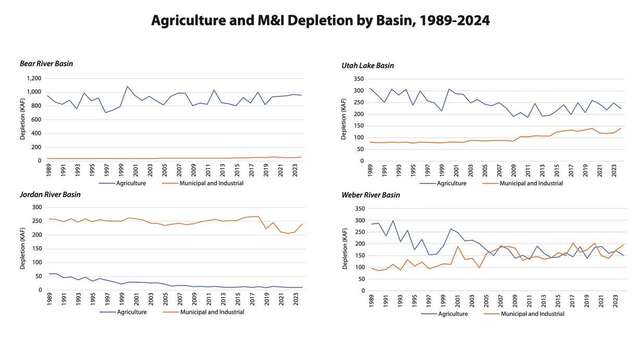
These graphs show depletion from agriculture and municipal and industrial (M&I) uses within the Great Salt Lake's primary tributaries from 1989 to 2023. (Photo: Great Salt Lake Strike Team)
The data is based on consumption through 2023. All basins reported drops during drought conservation measures between 2020 and 2021, but it increases were seen by 2023. It doesn't take into account the last two years, where several municipal water suppliers reported seeing upticks in water consumption.
It makes it clear that municipal and industrial use is now the "biggest driver" in the lake's system, and that one industry is not the problem, says Utah House Majority Leader Casey Snider, R-Paradise.
"It's an 'us' problem," he said. "What we have to do as lawmakers ... is make sure that avenues to get water to the lake are clear and identified and available on a timeframe that makes sense."
Addressing municipal and industrial water
Utah lawmakers have addressed some of the lake's big depletion sources in recent legislative sessions. These include large investments in a program that helps farmers and ranchers become more efficient with the water they consume, as well as new water-saving policies for companies that extract minerals from the lake.
That's on top of several other programs that have essentially rewritten complicated water laws to make it easier for water rights holders to send water to the lake, as well as new funding for more donations and water-saving projects.
The 2026 legislative session, which begins next week, might focus more on municipal water and industrial consumption, based on a few bills that are already being proposed.
Proposed laws to address municipal water use
- HB76, sponsored by Rep. Jill Koford, R-Ogden, calls on large data centers to report water consumption and efforts to reduce it.
- HB154, sponsored by Rep. Doug Owens, D-Millcreek, calls for a state study of water loss.
- HB155, also sponsored by Owens, proposes steeper costs for residential water users who consume higher amounts to "provide a clear price signal or financial incentive to a customer to consider reducing the customer's water use."
- SB46, sponsored by Rep. Keven Stratton, R-Orem, would impose new landscaping requirements at state government facilities, including limits on when overhead spray irrigation is allowed, and more effort to include water-wise landscaping.
More bills could be considered through the session, which ends on March 6. It could build on previous efforts to promote xeriscaping and other outdoor watering practices.
"We have a whole menu of things that we can choose from," Snider said, pointing to growing efforts across all water uses. "That's how we're going to fix it. ... It is solvable when we just put our heads down and go to work."
Other potential measures in 2026
A report coming out this month will outline potential mitigation strategies and estimated costs for dust coming off dry spots in the Great Salt Lake, but state officials say all the efforts now leave Utah with a "flexible" water law that may help the Great Salt Lake recover one day and avoid those situations.
It empowers people to make beneficial decisions for the lake or Colorado River, which is better than most other Western states dealing with similar water situations, says Joel Ferry, director of the Utah Department of Natural Resources, and the state's water agent.
His department plans to unveil a new water leasing program this year that streamlines the concept, focusing on making sure any water saved ends up in the lake, building on what's already been done. The system, he says, will be "very technical and very complicated" to make sure water is precisely tracked in 2026 and beyond.
"You'll see big money coming into it and big results," he said, speaking at a strike team event last week. "It's going to help us as we deliver these hundreds of thousands of acre-feet to the Great Salt Lake."
Contributing: Bridger Beal-Cvetko