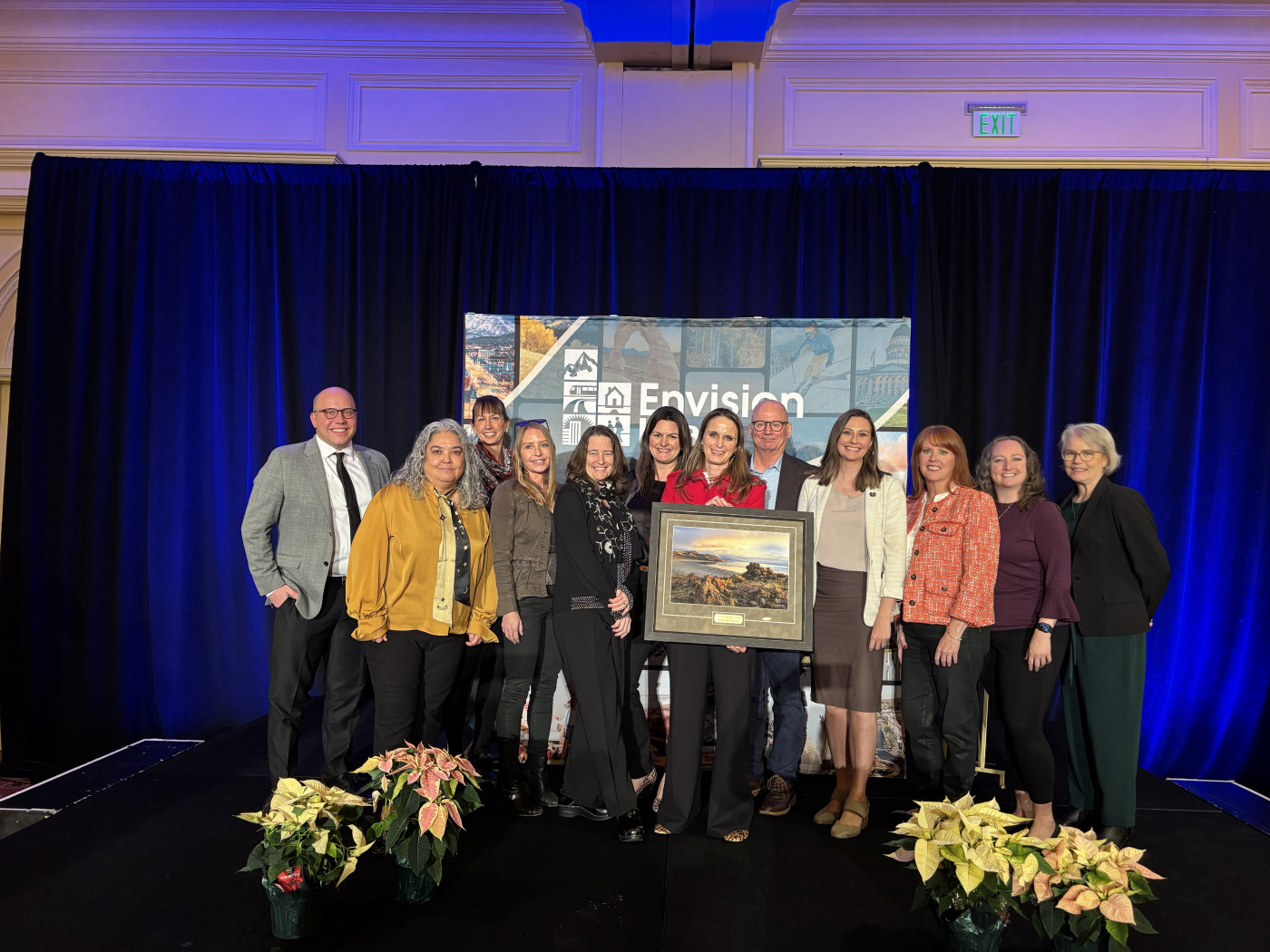
Envision Utah honors Great Salt Lake Collaborative for its work on educating Utahns about the lake.
Envision Utah, the nonprofit that engages Utahns on how they want the state to grow, awarded the Great Salt Lake Collaborative a Common Good award at a banquet at The Grand America Hotel Thursday.
The award honors individuals and organizations that "make significant contributions to the 'common good' of our state and community."
The Great Salt Lake Collaborative launched in 2022 with the mission to educate Utahns about the crisis of a shrinking Great Salt Lake and potential solutions, through journalism. Twelve member newsrooms share articles with each other about the lake and water and work on major projects together. They are joined by nine nonpartisan community organizations that work on education and engagement projects.
The following is an excerpt of the acceptances speech given by Great Salt Lake Collaborative director Heather May:
This award is meaningful because it underscores something core to our mission: Local news is a public good.
It is gratifying that Envision Utah sees how it benefits everyone when people are informed, connected and ready to act.
We improve our communities by going out and asking questions we think or we know you would ask. Like,
- Is the water saved at farms with taxpayer money making it to the lake — and should it?
- What growing cities don’t require water-wise yards and why?
- How much water do data centers use (and why don’t we know)?
Then we report the fact-checked answers. We’ve produced these stories and more — 1,000 plus — since we launched in 2022. Our member newsrooms have increased their coverage of the lake a whopping 20-fold compared to the years before we formed.
We do our job and then you can decide what to do with that information. And we’ve seen so much action:
- Utahns ripping out their lawns;
- Activists dressing as brine shrimp and birds and protesting;
- Lawsuits filed;
- Major art works;
- Water donations to the lake.
And just like we saw an increase in water coverage, we’ve seen a jump in new water policies: in 4 years, more than 100 bills related to water or the lake have passed.
While we focus on reporting on solutions, we don’t advocate for any of them.
But we do want the lake to be saved. Like you, we live here and we care deeply about what happens. We breathe in the dust from the lakebed, we benefit from Lake Effect powder. We care how Utah uses water because it is essential to our way of life, too.
No one has saved a lake that’s reached this level of crisis before. Here are three reasons why I believe the Great Salt Lake Collaborative is part of how it can work here for the Great Salt Lake:
1. Our community partners: Amplify Utah; Great Salt Lake Institute at Westminster College; Janet Quinney Lawson Institute for Land, Water & Air at Utah State University; Salt Lake Community College Community Writing Center; Salt Lake Community College Geosciences Department; Utah Humanities; and Utah Film Center.
We’ve done really innovative things with partners like these, including creating community anthologies and teaching journalism students about the lake. Our work was the basis of zines made by kids and an amazing play that, of all things, featured a collaborative reporter. How cool is that?!
2. Our funders including Solutions Journalism Network; Janet Quinney Lawson Institute for Land, Water & Air at Utah State University; The Nature Conservancy; University of Utah College of Humanities; Ducks Unlimited; Great Salt Lake Audubon; The Bur Oak Foundation; and Great Salt Lake Artemia.
We are a nonprofit and literally could not exist without grants and donations by individuals and organizations committed to securing a better future for the lake and our state.
3. Our collaborative journalists, whose work we are all relying on to make informed decisions: Davis Journal, FOX 13 News, KSL.com, KSL NewsRadio, KSL-TV, KRCL, KUER, PBS Utah, The Salt Lake Tribune, Standard-Examiner, Utah News Dispatch and Utah Public Radio.
They have radically changed how we do journalism when it comes to the lake because they put your information needs above clicks and profit.
Finally, there may be no greater challenge than the one recently named to restore and protect the lake by the 2034 Winter Games. Gov. Cox said he wants to see the south arm of the lake rise to 4,198 feet above sea level.
That’s an increase of 7 feet in a lake that reaches a maximum depth of about 34 feet. It will require sending millions of acre feet of water that now feeds lawns, crops, industry and housing developments to instead flow to the lake.
It will take a huge change in how we live.
Without well-researched, fact-based stories that examine if the proposed solutions will work, we cannot improve the health of the Great Salt Lake. To have a chance of tackling hard problems, we must begin by agreeing on what’s true.
With trusted information.
Then it will be your turn to act. You can start by:
- Staying informed with our free newsletter, found at greatsaltlakenews.org, where all of our coverage is free.
- With telling your communities what you’ve learned.
- And by supporting local news through follows, subscriptions, and donations.